Hybrid work shows up everywhere now, from job postings and HR policies to decisions about how much office space a company actually needs. But the term itself is used loosely.
One company's "hybrid" might mean three fixed office days a week. Another might ask employees to come in whenever it makes sense for their team. Both can be hybrid arrangements, which is exactly why the term needs a clear definition before you can build a policy, choose software, or answer a candidate's question about what the job actually looks like.

Hybrid work means regularly splitting working time between the office and a remote location, usually home. There is no single standard schedule or model.
Two to three office days per week is a common hybrid pattern, although requirements vary by employer, role, industry, and country.
Common hybrid work models include fixed, flexible, team-scheduled, rotating, office-first, and remote-first arrangements.
The benefits go beyond flexibility: hybrid work can broaden the practical talent pool, improve the use of office space, and make in-person time more intentional.
Hybrid work also creates challenges, including coordinating attendance, managing shared desks and rooms, meeting inequity, proximity bias, and unclear expectations.
Successful hybrid work starts with a clear policy, not technology. As organizations grow, workplace management software can make it easier to coordinate attendance and manage shared desks, rooms, parking, and other resources.
What does hybrid work mean?
Hybrid work means splitting your working time between two or more locations, typically a company office and a remote location such as home, on a recurring basis rather than working exclusively in one place.
It sits between two other common work models: fully on-site work, where employees are expected in the workplace throughout their working week, and fully remote work, where there's generally no recurring requirement to work from a company office.
That's the core of the hybrid work meaning: employees regularly work both remotely and from a shared workplace. How that mix is defined, whether by day count, team, manager discretion, or employee choice, is where different hybrid work models start to emerge.
What is an example of hybrid work?
A typical hybrid schedule might have an employee working from the office on Tuesday and Wednesday and from home on Monday, Thursday, and Friday.
Another company might require three office days per week but allow employees to choose which days they come in. A third might leave the schedule to individual teams, asking employees to work together in person when collaboration is most useful.
All three are examples of hybrid work because employees regularly divide their working time between the office and a remote location.
What is a hybrid job?
When a job listing says "hybrid," it means the role isn't fully remote or fully office-based. You'll generally be expected to work from a physical workplace for some portion of your working time, with the rest completed remotely.
The exact split isn't standardized, so "hybrid" in a job listing can mean very different things depending on the employer. Before accepting a hybrid job, it's worth asking:
How many days per week or month are employees expected in the office?
Are those office days fixed or flexible?
Does the schedule vary by team or manager?
Is there a minimum attendance requirement?
Can the hybrid policy change over time?
In other words, hybrid means in a job that both office and remote work are regular parts of the role, but the specific balance depends on the employer.
Hybrid vs remote work vs in-office work
Hybrid, remote, and in-office work describe different ways of deciding where employees work.
Model | Where you work | How much office time |
In-office | Company workplace | Most or all working days |
Hybrid | Office + remote location | A recurring mix, defined by the employer, team, or employee |
Remote | Primarily outside a company office | Usually no regular office requirement |
Table 1: Differences between hybrid, remote and in-office work (2026).
The practical difference matters for employers as much as it does for employees.
A fully office-based company may provide permanent desks for most employees. A fully remote company may need little or no permanent office space. Hybrid companies sit somewhere in between: they still need physical workplaces, but employees don't necessarily need an assigned desk every day.
This creates new questions around space, scheduling, desks, meeting rooms, and other shared resources, which is where workplace management becomes particularly important.
Hybrid work vs flexible work
Hybrid work and flexible work are related, but they don't mean the same thing.
Hybrid work describes where people work. Employees regularly divide their time between an office and another location.
Flexible work is a broader concept. It can include flexibility over where employees work, when they work, or how they structure their hours.
For example, a company might require everyone to work in the office Tuesday through Thursday and allow remote work on Monday and Friday. That's a hybrid model, but employees have relatively little flexibility over where they work on a particular day.
Another company might require employees to work in the office three days per week but allow them to choose those days. That's both hybrid and more flexible.
Flexible working can also exist without hybrid work. An employee might work in the office every day but have flexible start and finish times.
Types of hybrid work models
The term hybrid work model covers several different structures rather than one standard schedule.
Hybrid work model | How it works | Main advantage | Main challenge |
Fixed hybrid | The company sets specific office and remote days. | Predictable attendance and easier planning | Less flexibility for employees |
Flexible hybrid | Employees choose their office days, usually within set guidelines. | Greater employee flexibility | Harder to predict office occupancy |
Team-scheduled hybrid | Teams or managers decide when employees should work together in the office. | Office time can be aligned with collaboration needs | Different teams may follow different schedules |
Cohort or rotating hybrid | Teams or groups alternate office days or weeks. | Helps manage limited office capacity | Requires careful coordination |
Office-first hybrid | The office is the default workplace, with some remote work allowed. | More regular face-to-face interaction | Less location flexibility |
Remote-first hybrid | Remote work is the default, with the office used when needed. | Greater location flexibility | In-person collaboration requires more planning |
Table 2: Table 1: Comparison of common hybrid work models (2026).
Is hybrid work usually two or three days in the office?
There's no universal rule, but research suggests that two to three days per week is a common hybrid pattern.
Gallup research (2023) found that hybrid workers came into the office an average of 2.6 days per week, although schedules varied considerably between organizations and teams.
More recent job-posting data shows similar variation. Indeed Hiring Lab found that among UK hybrid job postings specifying minimum office attendance in 2025, two days was the most common requirement at 56%, while 25% required at least three days. Its 2026 data indicates that two days remains the most common hybrid arrangement in UK job postings.
At the same time, some large employers are moving toward stricter attendance requirements. CBRE's 2026 Americas Office Occupier Sentiment Survey found that 89% of surveyed employers required at least three days of office attendance per week, up from 78% in 2025.
The takeaway isn't that there's one "correct" hybrid schedule. Expectations vary substantially by employer, market, industry, and type of work.
Benefits of Hybrid Work (Not the Obvious Ones)
Hybrid work has remained popular because it can offer benefits to both employees and employers when implemented well. Greater flexibility, less time spent commuting, better work-life balance, improved employee retention, and access to a broader talent pool. All of them are well-known.
But there are also benefits that don't get as much attention. Some only become apparent when you look at how hybrid work changes the way companies use their offices, allocate resources, and think about the purpose of in-person work.
Access to a broader talent pool
Hybrid work can expand the geographic area companies can realistically recruit from. Employees who only need to commute to the office a few times per week may be willing to live farther away than those expected to make the journey every day.
It doesn't remove geographic constraints in the same way fully remote work does, but it can give employers access to candidates beyond their traditional daily commuting radius.
More efficient use of office space
Hybrid work changes a basic assumption of traditional office planning: not every employee needs a desk at the same time.
That doesn't automatically mean companies should make their offices smaller. Instead, it creates an opportunity to match office space and resources more closely to how employees actually use them.
When desks, meeting rooms, and other shared resources are booked rather than permanently assigned, workplace teams can see which days are busiest, which areas are underused, and where demand exceeds capacity. This data can inform decisions about desk ratios, office layouts, meeting rooms, parking capacity, and ultimately how much office space the company needs.
More intentional office time
When employees are in the office every day, simply being there doesn't necessarily mean they're collaborating.
Hybrid work can encourage companies to think more deliberately about what the office is actually for. Teams can coordinate office days around activities that benefit from being done together, such as onboarding, workshops, planning sessions, and collaborative problem-solving, while leaving focused individual work for remote days.
The benefit isn't simply spending fewer days in the office. It's having a clearer reason for being there when employees do come in.
Disadvantages and challenges of hybrid work
Hybrid work also creates operational and management challenges that don't exist to the same extent when everyone works in the same place every day.
Benefit | Potential challenge |
Greater location flexibility | More complex attendance coordination |
Less frequent commuting | Teams may not be in the office at the same time |
More efficient use of office space | Desk and room contention on busy days |
Regular in-person collaboration | Hybrid meetings can disadvantage remote participants |
Greater employee autonomy | Managers need clear expectations and policies |
Table 3: Potential operational challenges of hybrid work for businesses (2026).
Hybrid work can cause coordination gaps
If office days aren't coordinated, attendance can become uneven. The office might be crowded on Tuesday and nearly empty on Friday, reducing the value of in-person time and making capacity harder to manage.
CBRE's 2025 survey illustrates this problem: 73% of surveyed organizations said office utilization was effectively at capacity on peak attendance days, compared with only 34% for average attendance.
The problem, in other words, isn't always insufficient office space. It can be too many employees wanting the same space on the same days. This is why many businesses use desk booking software such as Dibsido, which provides visibility into who plans to be in the office and helps employees coordinate their office days. See our guide on how to effectively schedule in a hybrid workplace to learn more.
Hybrid work can create desk and room contention
When fewer employees have permanent desks, shared resources need to be coordinated.
Without a hoteling system, employees can arrive without knowing whether a desk or meeting room will be available, while unused reservations and no-shows can make the problem worse.
Hybrid work can lead to meeting inequity
Hybrid meetings create another challenge. When some participants are together in a physical meeting room and others join remotely, remote employees can find it harder to participate equally.
Good meeting practices and appropriate room technology can help reduce this imbalance.
Hybrid work can contribute to proximity bias
Even though a study published in the prestigious scientific journal Nature in 2024 found no significant difference in performance reviews between employees working hybrid (two days from home and three in the office) and those working in the office five days a week, managers may still unintentionally give more attention or opportunities to employees they see in person more frequently.
Clear performance criteria and consistent management practices are therefore important in hybrid teams, particularly when employees have different office schedules.
Hybrid work can create unclear expectations
A common source of hybrid work friction is simply not having clear rules. Employees need to know how often they're expected in the office, whether specific days are required, how shared resources should be booked, and what happens when plans change.
That's primarily a hybrid work policy problem rather than a technology problem.
Is hybrid work going away?
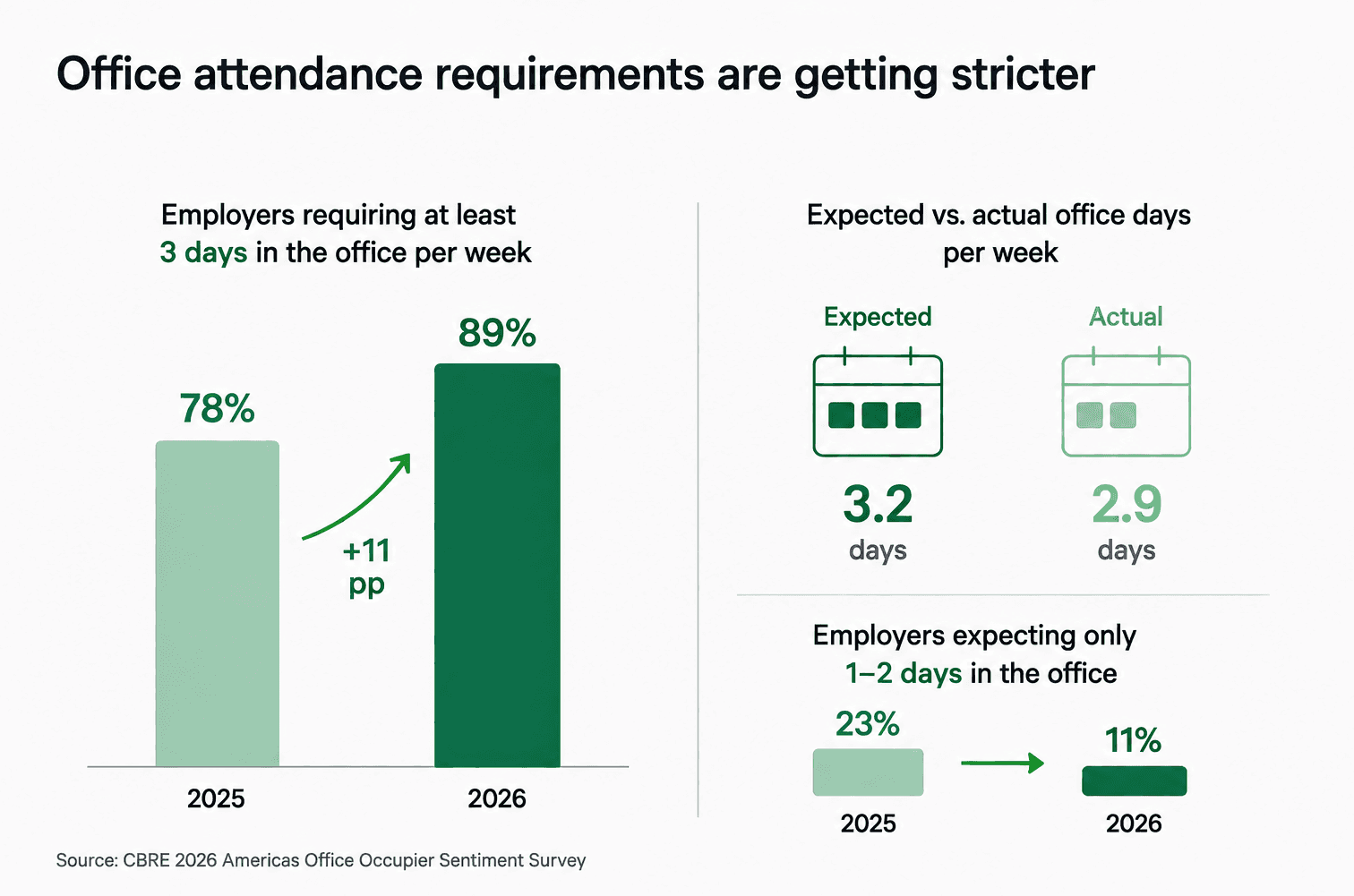
Hybrid work isn't disappearing, but it is becoming more structured.
Indeed Hiring Lab reported in August 2026 that 16.9% of UK job postings mentioned remote or hybrid flexibility, remaining close to previous highs. At the same time, its data shows employers gradually increasing office-attendance requirements within hybrid roles.
CBRE has observed a similar shift among office occupiers in the Americas. In its 2026 survey, 89% of employers required at least three days of office attendance per week, compared with 78% in 2025.
So the trend isn't simply a choice between "hybrid work" and "return to office." Many employers are retaining hybrid arrangements while defining more clearly how many days employees should spend in the workplace.
For companies, that makes coordination increasingly important. A three-day hybrid policy still needs a way to ensure that employees know when to come in and that desks, rooms, and other resources are available when they arrive.
How to successfully adopt a hybrid work model
There's no single hybrid model that works for every company. The right approach depends on the type of work employees do, the size and layout of the workplace, commuting patterns, company culture, and how much flexibility the organization wants to provide.
However, several practices can make hybrid work easier to manage.
1. Write down your hybrid work policy
Employees should be able to understand how the arrangement works without relying on informal team knowledge.
A hybrid work policy can cover:
required office days, if any
whether employees can choose their own days
expectations for team or company-wide office days
desk and meeting room booking
check-in and no-show rules
exceptions to the standard schedule
how and when the policy may change
Clear expectations reduce uncertainty for both employees and managers.
We've written the full breakdown, including an example policy and a template you can adapt, in Hybrid Work Policy: What to Include, With an Example and Template.You can also check out our free hybrid work policy template generator.
2. Design office days around the work being done
Simply requiring employees to be present doesn't guarantee useful collaboration. Consider which activities benefit most from being done face to face, such as onboarding, workshops, planning sessions, team problem-solving, or cross-functional collaboration, and coordinate attendance accordingly.
3. Make shared resources easy to book
In smaller companies, hot desking can work without a formal system, while in larger organizations, a hot desking system with an interactive floor plan is often essential (see the differences between hot desking and hoteling).
As permanent desk assignments become less common, employees need an easy way to find and reserve available desks, meeting rooms, and other resources.
If booking a resource requires an email thread or manually checking a spreadsheet, employees are more likely to bypass the process.
4. Track utilization instead of relying on estimates
Hybrid attendance can fluctuate substantially across days of the week. Booking and occupancy data can help workplace teams understand which days are busiest, which resources are underused, and whether the office has too much or too little capacity.
That information can support decisions about desk ratios, office layouts, parking capacity, or future real estate needs.
How does workplace management support hybrid work?
Workplace management is the practice of planning and managing the physical workplace and the resources employees use within it.
In a hybrid environment, that includes questions such as:
How many desks are needed on an average day?
Which days have the highest attendance?
How do employees find and reserve an available desk?
Are meeting rooms being used efficiently?
How should limited parking spaces be allocated?
Which parts of the office are consistently underused?
These questions become more important when attendance is no longer constant.
That's why workplace management and hybrid work are closely connected: hybrid work defines how and where employees work, while workplace management helps organizations provide the space and resources needed to support that arrangement.
How to actually manage hybrid work: policy first, then tools
Technology alone doesn't make a hybrid workplace successful. The first step is a clear hybrid work policy covering which days, if any, employees are required in the office, how teams coordinate their schedules, how shared resources are used, and what employees should do when their plans change.
Once those rules exist, technology can make them easier to follow.
Hybrid work software can help employees book desks, meeting rooms, or parking spaces while giving workplace teams better visibility into expected attendance and actual resource utilization.
The technology that makes hybrid work practical
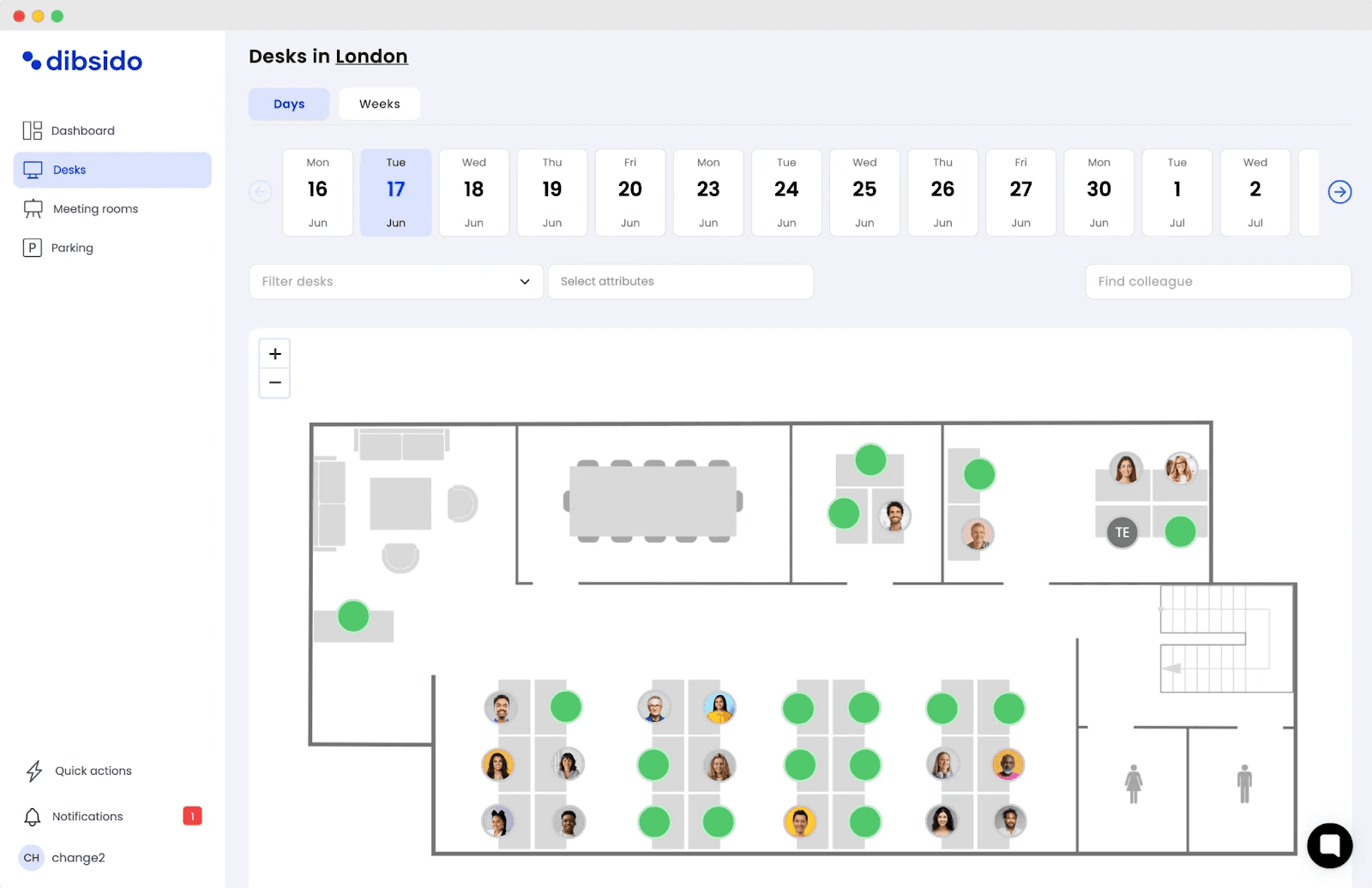
As a hybrid workplace grows, managing shared resources informally becomes increasingly difficult. This is where hybrid work software such as Dibsido comes in. Rather than using separate tools for every resource, modern systems typically bring several capabilities into one platform:
Desk booking and hot desking allow employees to see available desks and reserve one before arriving at the office.
Meeting room booking helps employees find and reserve shared rooms and reduces scheduling conflicts and unused reservations.
Parking management makes it easier to allocate and reserve limited parking spaces, particularly on busy office days.
Interactive floor plans help employees quickly find available desks, rooms, and other resources across the workplace.
Workplace analytics give facility and office teams insight into attendance patterns, resource demand, and office utilization.
The level of technology you need depends on the size of your workplace and how your hybrid policy works. A small team with ten desks may be able to coordinate informally, while an organization with hundreds of employees sharing desks, rooms, and parking spaces is likely to benefit from a centralized system.
If you're exploring hybrid work software, this evaluation guide can help you understand what to look for.
Hybrid Work Is Here to Stay: Define Policies First, Then Choose the Tools
Hybrid work isn't disappearing, even as companies become more structured about office attendance. The question for many businesses is no longer whether to embrace office or remote work, but how to make a hybrid model work effectively.
And that starts with policy, not technology.
A clear hybrid work policy should define which days, if any, employees are expected in the office, how teams coordinate their schedules, how shared resources are used, and what employees should do when their plans change.
Once those rules are in place, technology can make them easier to follow. And yes, for very small teams, that can be a spreadsheet. But as more employees begin sharing desks, rooms, and parking spaces across different schedules, a workplace reservation system becomes increasingly useful.
If you'd like to see how hybrid work software works in practice, try Dibsido for free.
FAQ
What does hybrid work mean?
Hybrid work means regularly splitting your working time between a company workplace and another location, usually home, instead of working exclusively on-site or remotely.
What is a hybrid job?
A hybrid job combines regular in-office and remote work. The exact split isn't standardized, so it's worth confirming how many office days are required and whether those days are fixed or flexible.
What is an example of hybrid work?
An employee might work in the office on Tuesday and Wednesday and from home for the rest of the week. Another company might require three office days but let employees choose them. Both are examples of hybrid work.
Is hybrid work usually two or three days in the office?
Two to three days per week is common, but there's no universal standard. Gallup research found hybrid employees averaged 2.6 office days per week, while Indeed's UK job-posting data shows two days as the most common minimum hybrid requirement. Requirements vary by employer, industry, role, and country.
What's the difference between hybrid and remote work?
Remote work generally doesn't require employees to work regularly from a company office. Hybrid work combines remote work with a recurring in-office component.
What's the difference between hybrid and flexible work?
Hybrid work describes where employees work, while flexible work is a broader concept that can include flexibility over location, hours, or schedules. A job can therefore be hybrid without giving employees complete flexibility over their office days.
What are the main types of hybrid work?
Common hybrid work models include fixed hybrid schedules, employee-choice or flexible hybrid, team- or manager-scheduled hybrid, rotating or cohort models, and office-first or remote-first approaches.
What is workplace management?
Workplace management involves planning and managing a company's physical workplace and resources, including desks, meeting rooms, space, and parking. In hybrid workplaces, it helps organizations match these resources to changing employee attendance.
What are the benefits of hybrid work?
Potential benefits include greater flexibility, reduced commuting, improved employee retention, access to a broader hiring area, regular opportunities for face-to-face collaboration, and more efficient use of office space.
A randomized controlled trial of 1,612 employees published in Nature found that working from home two days per week reduced quit rates by one-third without negatively affecting performance ratings or promotion rates.
What are the disadvantages of hybrid work?
Common challenges include coordinating office attendance, managing demand for desks and meeting rooms, running meetings fairly for both remote and in-person participants, proximity bias, and unclear expectations about when employees should come to the office.
Is hybrid work going away?
Current evidence suggests that hybrid work is becoming more structured rather than disappearing. Some employers are increasing required office attendance, but remote and hybrid flexibility remains common in many office-based roles.
Do I need special software to manage hybrid work?
Not necessarily. Very small teams may be able to coordinate desks and attendance informally. As more employees begin sharing desks, meeting rooms, parking spaces, and other resources, however, a booking system can make availability easier to manage and provide useful data about how the workplace is being used.
Our platform is designed to empower businesses of all sizes to work smarter and achieve their goals with confidence.