Most hybrid work started as an exception. People stayed home during a crisis, it worked well enough, and the arrangement quietly became permanent without anyone writing it down. That gap is where the friction lives. Nobody is sure which days they are expected in, teams end up in on different days and never see each other, and the office is packed on Tuesday and empty on Friday. A hybrid work policy closes that gap. This guide explains what a hybrid work policy is, what to put in one, and how to introduce it so it feels fair rather than imposed, with an example policy and a template you can adapt.

A hybrid work policy is a written set of expectations for how a team splits time between the office and home, covering how many days in the office, which days, who decides, and how it is tracked.
It matters because most hybrid setups drifted into place without being written down. Unwritten expectations are where the resentment builds, because everyone is following a slightly different version of the rules.
A good policy answers four questions plainly: how many office days, how those days are chosen, what the office days are actually for, and how exceptions work.
The fastest way to get a hybrid policy resented is to make it feel like attendance policing. Explain the reason for the office days, give teams some say over which days, and keep the tracking light.
Software makes the policy easier to run by letting people book desks for their in-office days and showing who is coming in when. Setting the policy and handling exceptions, though, stays a management decision, not something a tool does on its own.
Most hybrid work was never really decided. It happened. People worked from home out of necessity, it turned out to be workable, and the arrangement settled in without anyone writing down what it actually was. For a while that looseness felt like freedom.
The problem shows up later, in the small daily frictions. Nobody is quite sure which days they are meant to be in. Two people on the same team come in on opposite days and go weeks without overlapping. The office is jammed on Tuesday and a ghost town on Friday. One manager quietly expects three days, the manager next to them expects one, and the people who report to each compare notes and feel hard done by.
None of that is a hybrid problem. It is an unwritten-policy problem. This guide explains what a hybrid work policy is, what to put in one, and how to introduce it so it reads as a fair shared arrangement rather than a return-to-office order. It includes an example policy you can adapt and a template you can hand to your team.
What is a hybrid work policy?
A hybrid work policy is a written set of expectations for how a team divides its working time between the office and remote locations, usually home. At a minimum it answers how many days people are expected in the office, how those days are chosen, who the policy applies to, and how exceptions work. Better policies also say what the office days are actually for, because that reason is what justifies every other rule.
The point of writing it down is not bureaucracy. It is predictability. When the arrangement lives only in people's heads, everyone runs a slightly different version of it, and the gaps between those versions are where resentment collects. A short, clear policy replaces a dozen private assumptions with one shared expectation people can plan their week around.
It sits under the broader idea of flexible working, and the two often get folded together. A hybrid work policy is the specific part that governs the office-versus-home split. If you want to see where it fits alongside everything else that keeps a modern office running, our guide to workplace experience software covers the wider picture.
Why you need one now
When hybrid work was new, a loose arrangement was fine because everyone was improvising together. That grace period is over. The costs of leaving it unwritten have become concrete.
The first cost is coordination. Hybrid only pays off when the office days create the in-person time that is hard to get remotely: onboarding, quick problem-solving, the conversations that never make it onto a call. If people pick their own days at random, a team can go a month without being in the same room, and the office becomes a place to take video calls surrounded by other people taking video calls. At that point the commute buys nothing.
The second cost is fairness. This is the one that quietly damages trust. When there is no written standard, each manager sets an unwritten one, and comparable employees end up held to different expectations for no visible reason. People notice. A policy that applies the same expectations across similar roles is not about control; it is about not making the split feel arbitrary.
The third cost is space. Uneven attendance means you are simultaneously short of desks on the busy day and paying for empty ones the rest of the week. A policy that spreads attendance, paired with a way to see who is coming in when, is what makes the real estate add up. That same visibility is what a desk sharing setup depends on, and the two decisions are best made together.
What a hybrid work policy should include
A useful policy is specific without being exhausting. These are the areas worth covering.
Who it applies to. Name the roles or teams the policy covers, and be explicit about any that are fully remote or fully office-based, so the split does not look like favouritism.
How many office days. State the expectation plainly, whether that is a number of days per week, a monthly minimum, or a set of fixed days. Vague wording like "come in regularly" is what everyone interprets differently.
How those days are chosen. Decide between fixed company-wide days, fixed days set per team, or flexible days with a minimum. Each has trade-offs, and picking one openly beats leaving it to chance.
What the office days are for. This is the section most policies skip and the one that matters most. If the answer is collaboration, team time, or onboarding, say so, because it tells people how to use the days well.
How desks and space are booked. If desks are shared, say how people reserve one for their in-office days and how they check in, so nobody drives in to find nowhere to sit.
How exceptions work. Cover illness, focus days, personal circumstances, and how someone requests a change. A policy with no room for exceptions gets broken quietly instead of adjusted openly.
Ownership and review. Say who owns the policy and when it gets reviewed. Hybrid norms are still settling, so a policy you revisit beats one carved in stone.
You do not need a rule for every edge case. A handful of clear answers people can remember beats a long document nobody opens.
An example hybrid work policy
Here is a short example you can adapt to your office. Keep it roughly this brief. If you want a version filled in with your company name and setup, you can generate a customised hybrid work policy with our free tool.
Hybrid Work Policy
Purpose. To give everyone a predictable, fair arrangement for splitting time between the office and home, and to make sure our office days are worth coming in for.
Scope. This policy applies to all employees whose roles can be done in a hybrid pattern. Roles designated as fully remote or fully office-based are listed separately and are not covered here.
The arrangement.
1. Employees are expected in the office two days a week.
2. Each team sets its own two anchor days so the whole team is in together, and shares them at the start of each quarter.
3. Office days are for collaboration, onboarding, and team time. Days that are mostly solo focus work can be done from home.
4. Book a desk in the app for the days you are coming in, and check in when you arrive so the space stays accurate for everyone.
5. Need to change your days for a given week? Agree it with your manager in advance. Illness and personal circumstances are always fine.
Responsibilities. Every employee is responsible for meeting their in-office days and keeping their bookings up to date. Managers are responsible for setting fair team days and handling exceptions consistently. The people team reviews this policy every six months.
A hybrid work policy checklist
For rollout, a checklist is easier to work through than a policy document. Use this to pressure-test your draft before you share it.
Before you publish the policy:
The number of office days is stated as a specific expectation, not "regularly"
It is clear how the days are chosen: company-wide, per team, or flexible with a minimum
The policy says what the office days are for, not just that they are required
Fully remote and fully office-based roles are named, with the reason
There is a clear, low-friction way to request an exception
Desk booking and check-in are explained if desks are shared (a separate hot desking policy template covers the details)
The same expectations apply across comparable roles, not manager by manager
It fits on one page and an owner and review date are named
A checklist like this catches the gaps that cause disputes later, especially the ones around fairness and how days are chosen.
How to introduce a hybrid work policy without resentment
Hybrid policies have earned a bad reputation, mostly because many arrived as thinly disguised return-to-office mandates. If your rollout reads that way, people comply on paper and resent it in practice. A few principles keep it on the right side of that line.
Explain the why, not just the number. People accept two office days far more readily when they understand the days exist for real in-person work, not attendance for its own sake. Lead with the reason.
Give teams a say in the days. The single biggest driver of buy-in is whether people had any input. Letting each team pick its own anchor days, within a clear minimum, turns a rule into a shared decision.
Make the office days worth it. A policy cannot fix days spent on video calls you could have taken from home. Pair the policy with a genuine reason to be in: team days, onboarding, planning sessions.
Keep the tracking light. Booking a desk and checking in is reasonable. Monitoring who badged in at what minute is surveillance, and it poisons the whole arrangement. Aim for visibility, not scrutiny.
Keep it short and revisit it. A one-page policy you review every six months signals that you are still listening. A long, fixed document signals that the decision has already been made about them, not with them.
If getting people to actually adopt the new routine is the worry, the same lessons apply as with any workplace tool. Our guide to getting employees on board with desk booking software and the one on rolling out desk booking without pushback both cover the adoption side that a hybrid policy leans on.
Where desk booking fits
A hybrid work policy is a people policy first. Software does not set it and cannot replace it, but it does make the day-to-day of running one far less painful.
Once you have decided how many office days and which ones, the practical question becomes: is there space for everyone on the busy day, and can people see who else is coming in? That is what desk booking answers. People reserve a desk for their in-office days, check in when they arrive, and the app shows the week filling up. For a team trying to hit its anchor days together, being able to see that everyone has booked the same Tuesday is what makes the policy real rather than theoretical.
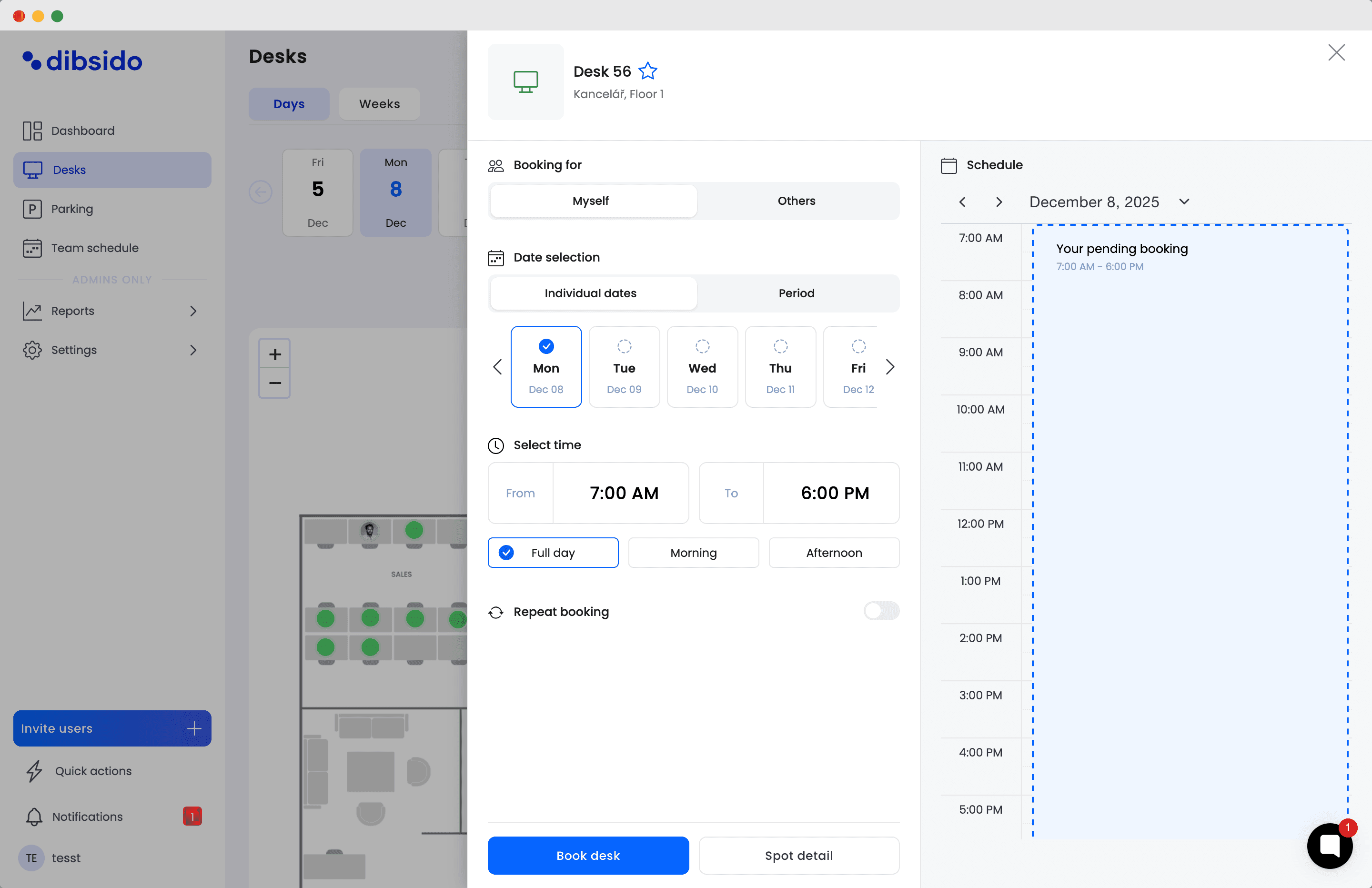
The visibility runs both ways. Because bookings and check-ins are recorded, whoever owns the policy can see whether the office days are actually happening and how full the office gets on each day. That is the information you need to know if two anchor days are enough, whether a team is quietly ignoring the arrangement, or whether you are paying for more space than you use.
What software does not do is set the policy or enforce it for you. A tool can show that someone booked a desk and never checked in, or that a team keeps missing its office days, but the decision about what to do next is a management one. Keep the policy and the tooling in their own lanes: the policy sets the expectation, the tool makes it visible and easy to follow, and people make the judgement calls.
Dibsido handles desk booking with check-ins and attendance reporting, so each in-office day has a booked desk and the people running the office can see who is coming in when. It is free for up to 10 users, no credit card required. Try it free or book a short demo to see how it fits the way your team works hybrid.
Hybrid work policy FAQ
What is a hybrid work policy?
A hybrid work policy is a written set of expectations for how a team splits its working time between the office and remote locations such as home. It usually sets out how many days people are expected in the office, how those days are chosen, who the policy applies to, what the office days are for, and how exceptions are handled. Its purpose is to replace unwritten assumptions with a shared, predictable arrangement everyone can plan around.
What should a hybrid work policy include?
A practical hybrid work policy covers who it applies to, how many days per week are expected in the office, how those days are chosen (fixed company days, fixed team days, or flexible with a minimum), what the office days are for (collaboration, onboarding, team time), how desks and space are booked, how exceptions and fully remote roles are handled, and who owns and reviews the policy. It should be short enough that people actually read it.
How many days a week should employees be in the office?
There is no single correct number, and it depends on the work rather than a benchmark. Most hybrid offices land on two or three in-office days a week. Fewer than two often means teams rarely overlap in person, which removes the main reason for coming in. More than three starts to feel like full-time office work with extra rules. The better question is not how many days but what those days are for, then choosing the minimum that achieves it.
How do you write a hybrid work policy?
Start by deciding what the office days are actually for, because that reason justifies every rule that follows. Then answer four questions in plain language: how many office days, how those days are chosen, what people should use them for, and how exceptions work. Keep it to one page, explain the reasoning rather than just stating rules, and give teams some say over which days they come in. A policy people understand and had input into gets followed; one imposed top-down gets worked around.
What is the difference between a hybrid work policy and a flexible working policy?
A hybrid work policy specifically covers the split between office and remote work: how many days in the office, which days, and what they are for. A flexible working policy is broader and can cover flexible hours, compressed weeks, job shares, and remote work as a set of arrangements employees can request, often with a formal process. Hybrid work is one form of flexible working, so many companies fold the hybrid rules into a wider flexible working policy or keep a short hybrid policy alongside it.
How do you make a hybrid work policy feel fair?
Fairness comes from consistency and voice. Apply the same expectations across comparable roles rather than letting each manager set their own unwritten version, which is the most common source of resentment. Give teams a say in which days they come in instead of dictating them from the top. Be explicit about which roles are fully remote and why, so the split does not look arbitrary. And make sure the office days deliver something worth the commute, rather than sitting on video calls you could have taken from home.
Do you need a hybrid work policy if you only have a couple of office days?
Yes, and arguably more so. A light hybrid setup is exactly where expectations drift, because with only one or two office days the odds of a team all being in on the same day by chance are low. Without a written policy, people pick different days, never overlap, and conclude the office days are pointless. A short policy that names which days matter and what they are for is what makes a small number of office days actually worth it.
How do you enforce a hybrid work policy?
Enforcement works best as a visible, consistent norm rather than a crackdown. Make the expectation clear, make it easy to see who is coming in when, and have managers address persistent gaps directly and privately. Software can support this by letting people book desks for their office days and by surfacing attendance and utilization patterns, but the decision about how to handle someone who repeatedly misses their in-office days is a management one, not something a tool applies automatically.
Our platform is designed to empower businesses of all sizes to work smarter and achieve their goals with confidence.