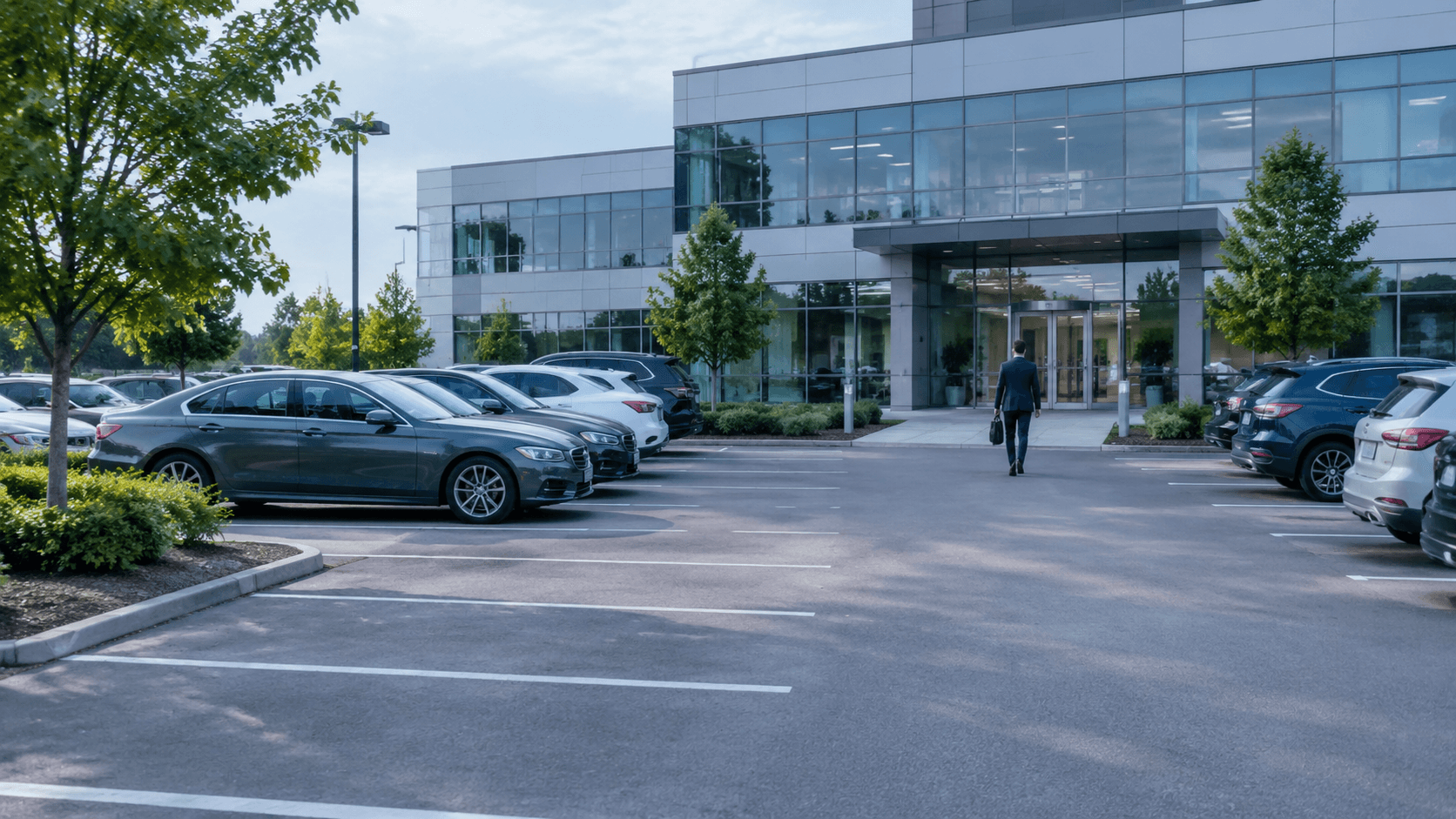
Your car park is full by nine and people are circling for a space, yet walk it at lunchtime and a row of reserved bays sits empty. Both are true at once, and the number that explains the gap is parking utilization. Here is how to measure it, what a healthy rate looks like, and how to free up the spaces you already have.

Parking utilization = spot-hours actually used divided by spot-hours available. A car park that feels full is not the same as one that is actually used.
The number most offices accidentally track is how many spaces are assigned, not how many are occupied. Permanently allocated bays, no-shows, and leave or travel all keep spaces reserved while they sit empty.
There is no single correct target, but very low utilization usually means too many permanent allocations, and very high utilization means people genuinely cannot find a space when they drive in.
You can measure real usage from booking plus check-in data. You do not need occupancy sensors or cameras to start.
Once you have the number, the fixes are operational: pool idle reserved bays, release no-shows, and allocate on the days people are actually in rather than by permanent name plate.
It is nine in the morning and the car park is already full. A couple of cars are waiting at the barrier, someone has given up and parked on the street, and the office manager is getting the same message they get every week: we do not have enough parking. Then walk the same car park at lunchtime. A whole row of reserved bays, the ones with name plates and permits, sits empty. One of them belongs to someone who, by the stories you hear on sales calls, has been in the office roughly once all year.
Both pictures are real at the same time. The barrier queue says you are out of spaces. The empty reserved row says you have plenty. The number that reconciles the two is parking utilization, and almost no office actually measures it. They measure how many bays are assigned, which is a completely different thing and the reason the complaints never stop no matter how you reshuffle the permits.
This guide walks through what parking utilization really measures, how to calculate it, what a healthy rate looks like, why spaces sit empty while the lot feels full, and how to measure real usage without putting a sensor under every bay.
What parking utilization actually measures
Parking utilization is the share of available parking time that is actually used. The important word is "used." You are not measuring how many spaces are assigned, how sought-after they are, or how loudly people complain. You are measuring occupied capacity against total capacity, the same logic that sits behind office space utilization for the building as a whole. A parking space is an expensive, fixed asset, often rented by the bay, and every hour it stands empty while reserved is capacity you are paying for and not getting.
The metric only becomes useful when you are strict about the difference between three numbers:
Available spot-hours: how many hours your spaces could realistically be used, usually the working day across the days people drive in.
Allocated or booked spot-hours: how many of those hours are reserved, whether by a permanent name plate or a day booking.
Used spot-hours: how many of those reserved hours actually had a car in the bay.
Most offices stop at allocated. That is the trap. Allocation tells you about paperwork. Used tells you about the car park. The distance between them is where both the cost and the frustration live.
The gap between allocated and used (why the lot lies)
A traditional car park records intentions, not attendance. A senior hire negotiated a named bay three years ago and now works from home two days a week. A field team has permits but spends half the week at client sites. Someone is on two weeks of leave and their space stays theirs the whole time. None of these people are doing anything wrong, and every one of them leaves a reserved bay empty while a colleague circles for somewhere to park.
Stack a handful of those and the arithmetic turns ugly fast. If 10 of your 40 bays are permanently allocated and their holders are in three days out of five on average, that is 20 bay-days a week sitting empty but unusable, locked behind a name plate. That is often the entire reason a car park feels short. You are not out of spaces. You are out of spaces that are available, because the empty ones belong to someone who is not there.
This is the same pattern that shows up with desks, which is why the fix for desk booking no-shows and the fix for empty-but-reserved parking are close cousins. In both cases the leak is the gap between the reservation and the reality, and in both cases the cheapest capacity you own is the capacity you are already wasting.
How to calculate parking utilization
The formula is deliberately simple:
Parking utilization = used spot-hours ÷ available spot-hours × 100
Take a car park of 20 spaces, usable 10 hours a day, 5 days a week. That is 1,000 available spot-hours in a week. If cars genuinely occupy 550 of those hours, utilization is 550 ÷ 1,000 = 55 percent. For a simpler daily version, count how many spaces had a car in them on a given day against how many spaces exist. Twenty-eight cars across a day in a 40-space lot is a 70 percent peak day.
The honest part is choosing the inputs. If you put allocated hours into the "used" slot, you will get a flattering number that matches the full-looking lot and tells you nothing, because a named bay reads as 100 percent used whether its owner showed up or not. The measurement only earns its keep when the top of the fraction is real occupancy, which means you need a way to tell an occupied bay from a merely assigned one. That is the next section.
A quick note on "available." Counting spaces as available 24 hours a day will deflate every figure into the teens and make a busy car park look abandoned. Use the hours cars are actually there, the working day on the days people commute in. For most hybrid offices that is three or four real days a week, not a theoretical seven.
What counts as a good parking utilization rate
There is no universal correct number, and anyone quoting one precise figure as the industry standard is guessing. What matters is the direction the number points.
As a rough working range, many offices treat 70 to 85 percent at peak as healthy for shared parking. Parking sits higher than you would want for desks or rooms because an empty bay has no fallback, when it is full, someone is on the street. Here is the reasoning rather than a borrowed statistic:
Under about 60 percent: you probably have too many bays tied up in permanent allocations, or you have more parking than your in-office days need. The classic version is a car park full of named spaces when most of the team drives in on the same two days and nobody drives the other three.
Roughly 70 to 85 percent: a comfortable peak where people can usually find a space on the days they come in without the lot sitting half empty the rest of the time.
Above about 90 percent: this looks efficient, but it usually means people routinely arrive and cannot park. A full car park and "there is never anywhere to park" are the same story told from two sides.
The point of the benchmark is not to hit a magic percentage. It is to notice when you are far outside the range and to ask the follow-up question: is this a shortage of spaces, or a shortage of spaces that are actually available? For most offices it is the second, which is the cheaper one to fix.
Why spaces sit empty when the car park is full
When you break a full-feeling, low-usage car park down, the empty-but-reserved time almost always comes from the same handful of sources:
Permanent allocations. Named bays assigned to people who are now hybrid, travelling, or part-time. The bay is loyal even when its owner is not there.
No-shows. Someone reserves or claims a spot for a day they then work from home, and never releases it.
Leave and travel. Holidays, sick days, and off-site weeks all leave an assigned bay dark for days at a stretch.
Reserved-type bays. Visitor, EV charging, and accessible spaces are correctly protected, but when they are managed as fixed and never pooled, they can sit idle while general parking overflows.
Noticing which of these dominates is the whole game, because the response is different for each. Permanent allocations need a move to day-level booking. No-shows need a release rule. Leave and travel need spaces that free themselves when their holder is away. You cannot tell which lever to pull until you can see the gap, which brings us back to measurement. If the underlying problem is simply more staff than spaces, the workplace parking management playbook covers the allocation side in more depth.
How to measure car park usage without sensors
You will see a lot of advice that says the only real way to measure parking utilization is ground sensors, barrier counts, or camera-based plate recognition. Those are accurate, but they are also a hardware project, a budget line, and a procurement cycle, and you do not need them to start. For most small and mid-sized hybrid offices, a parking booking system already holds most of the data.
Here is the practical, no-hardware version:
Booking data gives you reserved spot-hours per bay, per day.
A check-in step, a quick confirmation in the app on the day, shows a reserved spot was actually taken. A booking nobody confirms is a no-show.
Used spot-hours are then your confirmed bookings, and no-show rate is the reservations that were never claimed.
That gives you a genuine usage number, derived from reservations and check-ins rather than sensor feeds or number plates. It is not perfect, someone occasionally forgets to confirm, but it is close enough to run decisions on, and it costs nothing beyond turning the feature on. Dibsido builds parking utilization from exactly this reservation and check-in data, with no occupancy sensors or cameras involved, which is the honest limit worth stating up front: it measures what people booked and claimed, not a motion reading of the tarmac.
What to do once you have the number
A utilization number on its own changes nothing. The value is in the action it unlocks, and the actions are mostly operational rather than technical:
Pool the idle allocations. The single biggest win is turning permanent name plates into day bookings so an empty bay is available to everyone else the moment its usual holder is not in. One space that a hybrid employee uses two days a week can now serve a second person the other three.
Turn on reminders and auto-release. A day-before nudge asking whether someone still needs their spot, plus automatic release of bookings nobody claims, recovers most no-show time. Dibsido sends that reminder and frees unclaimed spots on its own.
Allocate on attendance, not on hierarchy. Give people a fair way to reserve on the days they actually drive in. The scarcity is almost always on two peak days, so solving those two days solves the whole complaint. The fair parking allocation approach covers how to set this up without it feeling like a demotion for anyone who had a named bay.
Right-size the reserved types. Keep the visitor and accessible bays you genuinely need, but let bookable EV and visitor spaces flex back into the pool when they are not in use.
Re-measure. Utilization is a loop, not a one-off. Check it again after the changes and see whether the gap between allocated and used actually closed.
The through-line is simple. The software gives you the number, sends the reminders, and enforces the release rule you set, but the judgement about how many spaces you need, who gets priority, and how to handle the person who used to have a named bay, that part is yours. If you are choosing a tool to do the measuring, the parking management software guide walks through what to look for.
Parking utilization FAQ
What is parking utilization?
Parking utilization is the share of available parking time that is actually used. You measure occupied spot-hours against the spot-hours your car park could have been used during the day. It tells you whether your spaces are genuinely busy or just assigned, which is a different question.
How do you calculate parking utilization?
Divide the spot-hours actually used by the spot-hours available, then multiply by 100. For 20 spaces usable 10 hours a day across 5 days, that is 1,000 available spot-hours a week. If cars occupy 550 of them, utilization is 550 divided by 1,000, which is 55 percent. For a daily figure, count how many spaces were occupied against how many existed that day.
What is a good parking utilization rate?
There is no single correct number, but a rough working range for shared office parking is 70 to 85 percent at peak. Below about 60 percent usually means too many bays are permanently assigned to people who are rarely in. Above about 90 percent means people regularly arrive and cannot park, which is a capacity problem even though the lot looks efficient.
Why does the office car park feel full when spaces sit empty?
Because most car parks are allocated, not shared. A bay assigned to someone on leave, working from home, or travelling is still their bay, so nobody else can use it even though it is empty. Stack a handful of absent allocations and the open spaces fill by nine while reserved ones sit idle all day.
What is the difference between allocated and used parking spaces?
Allocated spaces are the ones assigned on paper, by name plate or permit. Used spaces are the ones with a car in them on a given day. The gap between the two is the single most useful thing to measure, because it is where wasted parking capacity hides and where the cheapest fixes live.
How do you measure parking utilization without sensors?
Use your booking data plus a check-in step. Booking data gives you reserved spot-hours. A check-in, by app or a quick confirmation on the day, shows a reserved spot was actually taken. Reservations that are never confirmed are your no-show rate, and used minus no-show gives you a practical measure of real usage without any hardware or cameras.
How do you free up unused reserved parking spaces?
Move from permanent allocation to day-level booking. People reserve a spot on the days they drive in, and bays that are not booked or not claimed go back into a shared pool for everyone else. A day-before reminder asking whether someone still needs their spot, plus automatic release of no-shows, recovers most of the idle time.
Does Dibsido show parking utilization?
Yes. Dibsido records parking bookings and check-ins and reports usage back to you, so you can see which spaces are busy, which sit empty, and where no-shows cluster. The numbers come from reservations and check-ins rather than occupancy sensors or cameras, and what you do with them, such as pooling idle bays or changing how spaces are allocated, stays your decision.
If your car park is full by nine but half the reserved bays sit empty, start by measuring the gap, not by renting more spaces. You can do it with the booking and check-in data you already have. Dibsido's parking booking software records both and reports the usage back, and the current plans are on the pricing page. You can try it free or book a demo if you want to see the reports first.
Our platform is designed to empower businesses of all sizes to work smarter and achieve their goals with confidence.