In one mid-sized office we talked to recently, the math was brutal: 67 parking spots, several hundred employees. People fight a lot for these spots, the workplace lead told us. Not metaphorically. Real disputes, real escalations to HR, real frustration that nobody knew how to solve. That ratio is extreme, but the underlying problem is everywhere. Most hybrid offices we work with have more people who could plausibly drive in than they have spaces to park. A fair parking allocation policy fixes this: not by adding spots you do not have, but by setting clear rules everyone understands.

Parking allocation is one of the most common daily frictions in hybrid offices: more drivers than spots, no clear policy, daily disputes that escalate to HR.
Four policy patterns fail consistently: honor system, permanent-by-seniority, first-come-first-served, manager discretion.
Four allocation methods actually work: daily booking, pre-booking with cancellation rules, credit-based, need-based hybrid.
The full framework: define scope, choose method, set rules, enable a system that enforces them, review quarterly.
Free policy template stub and an FAQ section answering the seven questions that come up most often (EV charging, no-shows, manager spots, review cadence, visitor parking, accessibility).
Without a written policy, parking becomes a daily contest. First-come-first-served favors early starters. Manager-assigned spots create resentment. Ad-hoc decisions feel arbitrary. Within a few months, parking stops being a perk and starts being a complaint stream.
A fair allocation policy fixes this. Not by adding spots you do not have, but by setting clear rules everyone understands, choosing an allocation method that matches your office reality, and using a system that takes the daily decisions off your plate.
This guide walks through the framework we use with workplace teams, with a free template stub you can adapt and a FAQ section that answers the questions that come up most often.
What is a parking allocation policy?
A parking allocation policy is a written document that defines who gets access to parking, how spots are assigned, and what happens when demand exceeds supply. It typically covers eligibility, allocation method, booking rules, no-show consequences, special cases (EV charging, accessibility, visitor parking), and the review cadence.
The policy is one half of the solution. The other half is the system you use to enforce it, because a policy nobody can apply consistently becomes the same chaos with extra paperwork.
Why most parking policies fail
Before the framework, four common failure modes worth flagging. If your current setup hits any of these, the policy itself is not the problem. The setup is.
The honor system without a tracker. Spots are "available" and people are "expected to be reasonable." What actually happens: 3-4 power users claim spots daily, everyone else gives up trying.
Permanent assignments to seniority or job title. Feels fair on paper because it follows org structure. Feels unfair in practice because juniors who drive in from further away and arrive earlier still cannot park, while senior people who take the train keep their assigned spot empty.
First-come-first-served with no booking. Rewards employees who arrive before traffic, which usually means starting earlier than they should or skipping the gym. Indirectly punishes parents on school runs and anyone in a different time zone.
Manager discretion. Means every parking conflict becomes a one-on-one HR conversation. Managers do not want this responsibility. Employees do not want their parking outcome to depend on whether their manager likes them.
A fair policy avoids all four by removing daily human judgment from the allocation decision.

The 5-step framework for a fair allocation policy
Step 1: Define the scope
Write down exactly what your policy covers. Skip this step and you will spend the next two years answering edge-case questions.
Cover:
Which buildings or sites the policy applies to
Which spots are in scope (employee spots, visitor spots, EV spots, accessibility spots, reserved spots for specific roles)
Who is eligible (full-time, part-time, contractors, interns, customers)
What "parking" means (just the lot, or also bike racks, motorcycle parking, drop-off zones)
You want the scope tight enough that the rest of the policy is unambiguous, and broad enough that you are not writing a separate policy for every category of person and vehicle.
Step 2: Choose your allocation method
This is the single highest-leverage decision in the whole policy. There are four allocation methods that actually work, each with a different fairness model.
Daily booking (first-come-first-served, but for the booking window). Spots open for booking at a set time each day. Whoever books first gets the spot. Fair in the sense that everyone has equal access to the booking window. Less fair if you have employees in different time zones or shift patterns.
Pre-booking with cancellation rules. Employees book spots up to N days in advance, with a deadline for cancellation (typically 24 hours). No-shows lose booking rights for a period. This is the most common method in offices we work with because it gives employees predictability and gives admins a way to enforce accountability.
Credit-based allocation. Every employee gets the same number of parking credits per month. Booking a spot spends a credit. Cancelling on time refunds the credit. Running out of credits means waiting for the next cycle. One workplace strategist we spoke with put it well: "I like the credit system because it allows everybody to have fair parking." Credits work especially well when demand consistently exceeds supply, because they force prioritization at the employee level instead of escalating to admin.
Need-based hybrid. A pool of spots is reserved for specific categories (people with long commutes, accessibility needs, EV charging) and the rest follow one of the methods above. This is the most administratively complex but the most accurate fit for offices with a wide range of employee circumstances.
Pick one as your primary method, and document what you chose and why. Avoid running two methods in parallel unless you have a clear hybrid policy. Mixed methods are where most "fair" policies quietly become unfair.
Step 3: Set the rules
Once the method is chosen, the rules write themselves. Cover at minimum:
Booking window: how far ahead can someone book, when does the window open
Cancellation rules: by when, how, what the refund is (if credit-based)
No-show consequences: what happens if someone books and does not arrive
Conflict resolution: what happens when two people both think they have the same spot
Special cases: EV charging time limits, visitor parking, accessibility spots
Policy exceptions: who can override the rules, in what circumstances, requiring what approval
Write these in plain language. Two sides of a printed page is the right length target. If you cannot fit it on two pages, the policy is doing too much.
Step 4: Enable the tools
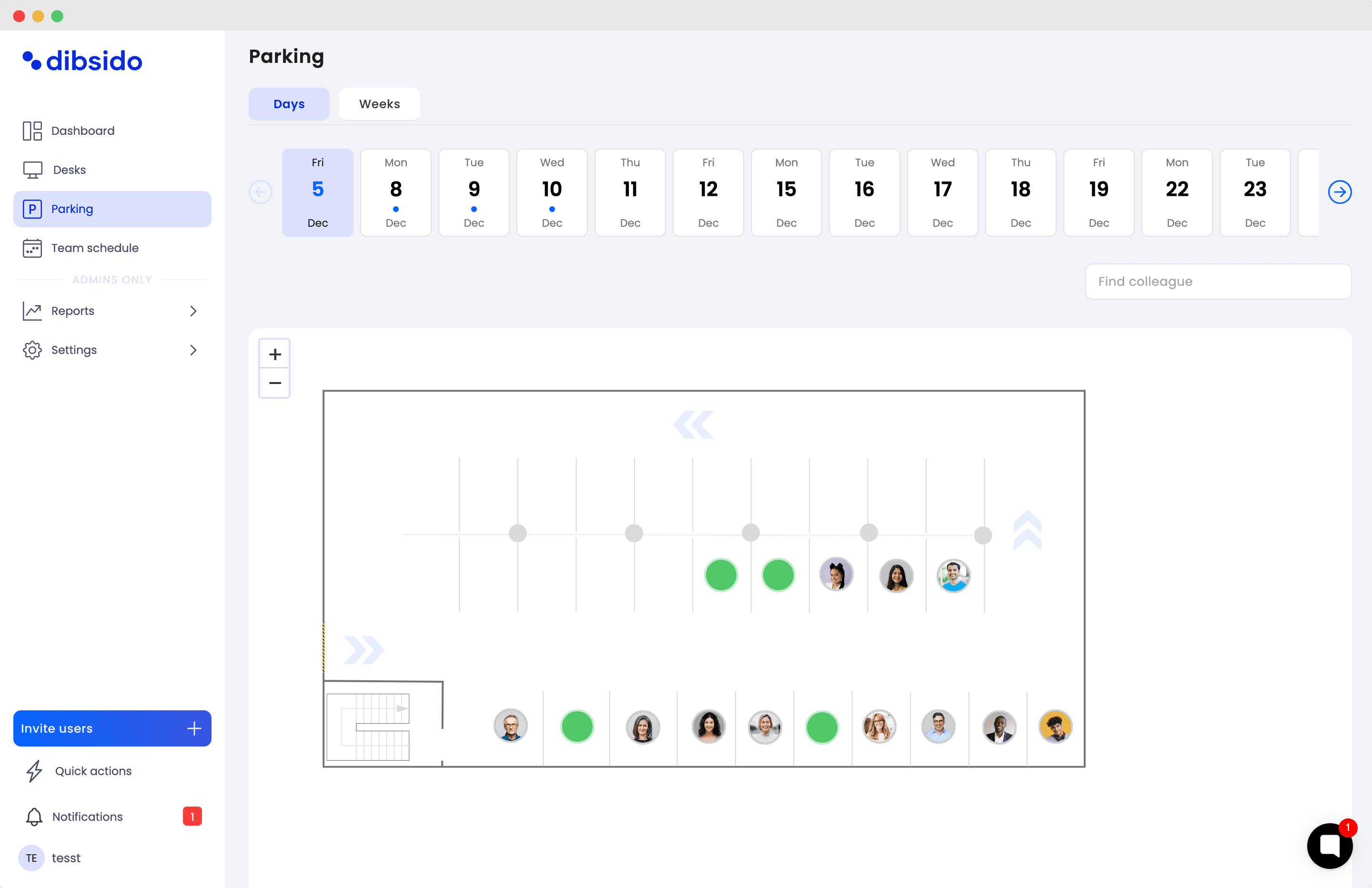
A written policy without a tool to enforce it is wishful thinking. The minimum requirements for any system you use:
Employees can see real-time availability before they decide to drive in
Booking takes under 30 seconds, ideally from a phone
Cancellation is just as easy as booking (this is what prevents most no-shows)
The system enforces the allocation method automatically, without admin intervention
Reports show actual usage, not just bookings, so you know whether the policy is working
A spreadsheet does not meet these requirements. A shared calendar might, for the smallest offices. A dedicated parking booking system meets them all and removes the daily admin burden entirely. For the buyer-side view of picking one, see our guide to employee parking management software.
Step 5: Review and adjust
Set a review cadence (quarterly works for most offices) and stick to it. At each review, look at four things:
Utilization: what percentage of spots are actually used vs booked
Conflict tickets: how many parking-related complaints came to HR or facilities
Demand pressure: is the booking window filling up immediately, or are spots still available
Edge cases: what categories of employee keep raising exceptions
Use the data to adjust. A policy that nobody changes for two years is either perfect (rare) or being ignored (common).
Free policy template (annotated structure)
Here is the structure we recommend. Each section below is a heading plus 2-3 sentences in your final document.
1. Purpose and scope
Which sites and spot types this covers
Who is eligible
2. Allocation method
Which method (daily booking, pre-booking, credit-based, or need-based hybrid)
Why this method was chosen
3. Booking rules
Booking window and opening time
Cancellation deadline and refund rules
No-show consequences
4. Special spot categories
Visitor parking
EV charging spots (with time limits)
Accessibility spots
Reserved spots (if any, and why)
5. Conflict resolution
First point of contact
Escalation path
Override authority
6. Tools and enforcement
Which system employees use
Where to find help
7. Review and changes
Review cadence
Who owns the policy
How changes are communicated
8. Effective date and version history
Capture the date the policy takes effect and a short changelog of edits. Two sentences are enough.
Fill each section to fit your office. Aim for the whole thing under two pages.
Make the policy work in practice
A written policy gets you halfway. Three things separate policies that work from policies that become wall art.
Communication. Announce the policy in writing once, then again in person at an all-hands or team standups. Send a one-pager summary that managers can share with new joiners. Put the booking link somewhere people will actually find it.
Enforcement consistency. Do not make exceptions in week one that you will refuse in week four. The first month sets the precedent for everything that follows. If the policy says no-shows lose booking rights for two weeks, that rule applies to everyone including senior leadership.
Visible feedback loop. Once a quarter, share what the data shows. Utilization percentages, conflict tickets resolved, any policy changes. Employees who see that the policy is being measured and adjusted will trust it more than employees who never hear about it again after launch day.
Frequently asked questions
What is the fairest parking allocation method?
There is no single fairest method. The right method depends on your supply-to-demand ratio and your employee mix. Credit-based allocation tends to feel fairest when demand consistently exceeds supply, because it forces each employee to prioritize their own parking days. Pre-booking with cancellation rules tends to work best when demand and supply are close to balanced.
How should I handle electric vehicle charging spots?
Treat charging spots as a separate category in your policy. A typical rule sets a 2-4 hour time limit, after which the driver moves the car to a regular spot. Your booking system's job is to flag which spots are EV-equipped so people know where charging is available. The time limit itself is enforced by team norms and policy communication, not the booking tool. Dibsido lets you pin EV stations on the map; the hourly limit is something your team agrees on and applies.
What if employees do not show up after booking?
Document the no-show rule in your policy before you need it. A common pattern is a two-strike system: first no-show is a warning, second within 30 days loses booking rights for two weeks. The booking system can surface who actually arrived so admins can see no-show patterns, but the suspension itself is enforced by people applying the policy, not automatically by the tool. The point is not to punish, it is to free up booked spots for people who would have used them.
Should managers have reserved parking spots?
Generally no, unless there is a specific operational reason (after-hours coverage, frequent client meetings on-site). Reserved spots based on seniority alone are one of the most consistent sources of policy resentment in our customer base.
How often should we review the policy?
Quarterly for the first year, then annually once the policy stabilizes. Major workplace changes (return-to-office shifts, headcount growth, building moves) should trigger an out-of-cycle review.
Do we need a separate policy for visitor parking?
Not usually. A short section inside the main policy that defines how visitor spots are booked (typically by reception or the host employee) is enough. Only spin out a separate policy if you have visitor volume that is comparable to employee parking demand.
How do we handle accessibility parking?
Accessibility spots should be reserved at all times for employees and visitors with appropriate documentation, regardless of the booking method used for other spots. Local regulations usually mandate a minimum number of accessibility spots, so check your local requirements first.
From policy to system
A good policy makes the rules clear. A good system makes the rules effortless to follow.
Dibsido handles all four allocation methods described above, plus the booking window, cancellation logic, no-show tracking (so admins can see who didn't show up and apply your policy), and utilization reporting your policy will reference. EV charging spots can be pinned on the office map. Setup takes about five minutes. You can write your policy and have the system supporting it the same week.
Try Dibsido free, no credit card, free forever for up to 10 users and 5 parking spots. Or book a demo if you want to see how the policy enforcement features work before rolling them out to your team.
Our platform is designed to empower businesses of all sizes to work smarter and achieve their goals with confidence.