Office hoteling software (often called desk booking or hot desk booking software) allows employees to reserve desks on demand instead of using permanently assigned seating. The market offers a wide range of solutions from lightweight tools for small and mid-sized teams to comprehensive workplace platforms designed for enterprise environments, with leading options including Dibsido, Robin, Deskbird, Envoy, Kadence, Eptura Engage, and Skedda.
Office hoteling software (also called desk booking or hot desk booking software) lets employees in hybrid offices reserve a desk in advance instead of holding a permanent assigned seat. The right tool prevents the "no-show desk" problem, surfaces who is in the office today, and integrates with the apps your team already uses (Microsoft Teams, Slack, Outlook). Below are the seven options worth comparing in 2026.
The market offers a range of solutions, from those tailored to small teams to platforms designed for enterprise use, spanning well‑established brands and younger, progressive players developing tools for modern workplace needs.
Despite their differences, these tools share many common features. The best office hoteling software should provide not only desk reservations but also a seamless user experience, easy integrations, basic analytics, and strong support for both admins and employees.
Here are seven top picks with their pros and cons. Data presented as of January 2026.
App | Free tier | Public starting price | Best for |
|---|---|---|---|
Dibsido | Up to 10 users | €1.70/user or €2.60/desk per month (annual) | Small to mid-sized hybrid offices |
Robin | No | Quote-based | Mid-market and enterprise |
Deskbird | 14-day trial | Per-user, public | Hybrid teams wanting a polished UX |
Envoy | No | Quote-based | Enterprises with visitor management needs |
Kadence | No | Quote-based | Workplace operations platform buyers |
Eptura Engage | No | Quote-based | Large enterprises (formerly Condeco) |
Skedda | Free tier limited | Per-space (per-room) pricing | Offices preferring per-resource pricing |
Office hoteling software lets employees reserve a desk, meeting room, or parking spot in advance for the specific days they come in, so a hybrid team can share fewer seats without double-booking. Unlike first-come hot desking, hoteling guarantees the booked spot and gives admins live usage data to right-size the office.
1. Dibsido

Dibsido stands out in the office hoteling software market for its highly intuitive resource scheduling tool. Its desk booking solution is competitively priced and designed for quick self‑onboarding. From day one, it offers full functionality, including interactive floor maps, analytics, advanced booking options, user management, mobile apps, and other features that competitors often reserve for higher‑tier plans or paid add‑ons.
The platform integrates with common workplace tools such as Google Calendar, Outlook, Office 365, Microsoft Teams, Slack, and more.
Dibsido’s desk booking solution is particularly well‑suited for small and mid‑sized companies seeking a straightforward, mobile‑friendly app. However, larger organizations also use it (e.g., Toyota, Samsung, Société Générale), especially those looking for a lightweight, easy‑to‑deploy system without complex setup.
Best fit:
Smaller, fast-growing, and mid-sized organizations
Pros:
Free trial and free plan for up to 10 users.
Affordable solution with transparent pricing.
Full functionality, including analytics, available from day one.
Consider:
Organizations at 5,000+ employees that need enterprise-grade visitor management with kiosk hardware, multi-tenant building administration, or custom BI dashboards may need a heavier workplace platform.
Limited advanced analytics (though sufficient for most SMBs).
Could benefit from deeper third‑party integrations, according to analysts.
At a glance: Dibsido sets up in about 5 minutes with no IT project, offers native desk, room, and parking booking inside Microsoft Teams and Slack, prices each module separately with a free plan, and scales to offices of 200 or more people.
2. Robin
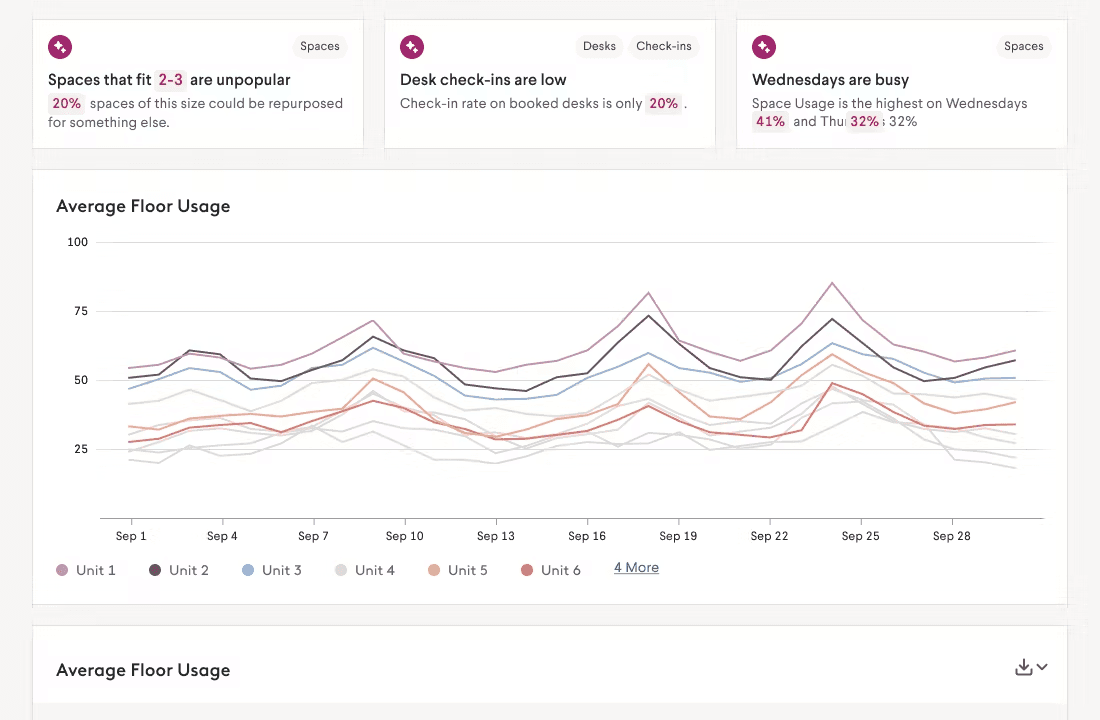
Founded in 2014, Robin is a well‑known platform for desk and room bookings, complemented by visitor management and workplace analytics. Designed for hybrid‑first environments, it integrates seamlessly with Microsoft 365, Google Workspace, Microsoft Teams, Slack, and other workplace tools.
Optimized for enterprise needs, Robin can feel heavier and more expensive than simpler solutions intended for small businesses. The company itself indicates that the platform is best suited for organizations with 500+ employees or at least 150 hybrid users.
Best fit:
Mid-sized businesses to large enterprises
Pros:
Strong reputation for ease of use.
Rich integration ecosystem with calendars and workplace tools (Google Workspace, Microsoft 365, Slack, Teams, etc.).
Robust analytics, including utilization dashboards, badge‑swipe check‑ins, and custom reporting.
Consider:
Trial requires sales engagement; the 14‑day trial is available only after booking a demo.
No public pricing.
Longer implementation and a slight learning curve, with reviewers and analysts estimating ~2 months to go live.
Businesses looking for a lighter Robin alternative may consider Dibsido as a suitable option.
3. Deskbird

Similar to Dibsido, Deskbird is one of the younger players among office hoteling software tools, built ultimately for modern needs.
Deskbird’s hot desk booking solution is part of its broader workplace management platform but can also be purchased as a standalone module (“Desks”) or combined with other products. This flexibility allows organizations to start with desk booking alone or expand into the full Deskbird platform as needed.
A strong focus on user interface design makes Deskbird easy to navigate, and its clean, straightforward layout is often praised by users on G2 and other review platforms.
The solution is best suited for mid-sized companies and enterprises. Larger organizations, or those requiring advanced features or extensive customization, may find it less suitable in certain areas.
Best fit:
Mid-sized businesses, enterprises.
Pros:
A free trial is available with no credit card required, and you can upgrade or cancel at any time.
Mobile apps for iOS and Android are included in every plan, so employees can book desks, rooms and parking on the go.
Teams can start the trial and set up the platform without talking to sales. Deskbird says most organizations are up and running within a few days.
Consider:
Organizations with specific workflows or complex permission settings may find customization options limited.
Advanced analytics features, including space utilization, are only available in the Enterprise plan.
For a side-by-side look at pricing, features, and reviews, see our Dibsido vs Deskbird comparison.
4. Envoy

Envoy’s hot desk booking solution is part of the Envoy Workplace platform. Its office hoteling tool is designed to maximize workspace utilization and help employees easily find a place to work on‑site.
Similar to most Envoy alternatives, this tool supports flexible seating in hybrid offices, allowing employees to reserve desks on demand while giving admins oversight of space usage and workplace capacity.
Envoy’s strong integrations, scalability across locations and teams, and all‑in‑one coverage make it a popular choice among larger, hybrid‑forward companies.
Best fit:
Mid-sized companies and enterprises
Pros:
Clean, straightforward interface; even first‑time users find it easy to navigate.
Sleek mobile experience with a dedicated app.
Robust integrations with calendars, communication platforms, single sign‑on providers, and other workplace tools.
Consider:
Quote‑based pricing can feel “enterprise‑y” for small teams.
Pricing starts at $60 per bookable resource/year which might feel “enterprise‑y” for small teams.
Some organizations report that certain workflows or floor plan nuances cannot be fully tailored.
5. Kadence

Kadence is a hybrid‑workplace platform that helps companies manage flexible offices. Its core modules include desk booking (hot desking/hoteling), meeting room booking, people scheduling, interactive office maps, and workspace analytics. The platform is designed to make it easy for employees to find a suitable place to work and for admins to manage policies and optimize space utilization.
Kadence is often adopted by small to mid‑sized organizations that want an intuitive, mobile‑friendly tool for hybrid work, and it can scale to larger environments. It is suitable for small to large businesses, though very small teams with simple needs may find it more feature‑rich and potentially pricier than necessary (for example, take Dibsido, a Kadence alternative, and compare the pricing).
Best fit:
Small and mid‑sized organizations
Pros:
Clean, intuitive interface for both web and mobile.
Strong feature set compared to peers, including AI‑powered booking suggestions.
Integrates with common workplace tools and supports API access for custom integrations.
Consider:
Fewer options for deep customization despite a strong default feature set.
Customer support, while helpful, can sometimes be slow to respond.
Users may need time to explore and fully utilize all features.
6. Eptura Engage (Formerly Condeco)
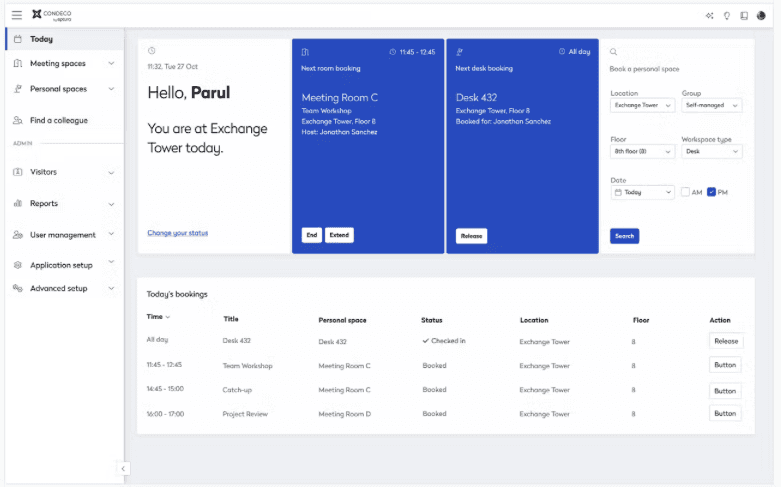
Condeco (now under Eptura as Eptura Engage) is positioned as an enterprise‑grade desk‑booking tool and is used by mid‑market organizations (250+ employees) through large enterprises. The solution is designed to support hybrid work and hot‑desking, providing a user‑friendly way for employees to book workspaces that meet their needs and locate colleagues on‑site.
Eptura Engage can be purchased as a standalone solution, but it is also part of a broader platform suite that, in addition to office hoteling, offers modules for asset management, visitor management, and office space management.
Best fit:
Mid-sized companies and enterprises
Pros:
Multiple booking methods and integrations: desks can be booked via web, mobile app, Outlook add‑in, or lobby kiosks.
Supports various desk types (fixed, flexible, hot‑desk) and booking rules to match company policies.
Easy to use for both employees and administrators.
Consider:
No free trial; Quote-based pricing.
Customer support and issue‑resolution times reported as inconsistent.
Some users have experienced issues with Outlook/Exchange or Teams integrations.
7. Skedda

No list of best office hoteling software would be complete without Skedda. The company has operated in the market since 2013 and today offers a desk booking solution as part of its broader cloud‑based workplace scheduling platform. It is not a standalone product limited to desks; rather, desk booking is one of several space management capabilities within Skedda’s system.
Skedda’s platform has a wide user base, illustrating that its desk booking tool can scale from small teams up to enterprise environments. This solution is commonly used to support hot-desking and hybrid work arrangements, enabling employees to reserve office desks on-demand while giving administrators oversight of space usage.
While not built solely for hot desking, it adapts well to a range of scheduling needs. For a side-by-side look at pricing, setup and features, see our Dibsido vs Skedda comparison.
Best fit:
Small, medium-sized businesses and enterprises
Pros:
Skedda’s desk booking solution is priced competitively for small to large teams.
The platform offers robust customization, admins can define complex booking rules, quotas, and user access permissions to align with company policies.
Strong integrations and accessibility.
Consider:
Not fully optimized for hot desking use cases.
No free plan. Unlike some Skedda alternatives, it does not offer a permanent free version of its product.
The high level of customization means the initial configuration can be complex.
Frequently asked questions
What is office hoteling software?
Office hoteling software lets employees in hybrid offices reserve a desk in advance instead of having an assigned seat. It typically integrates with calendar tools and chat apps so booking happens where people already work, without switching to a separate web app.
What's the difference between office hoteling and hot desking?
Hot desking is "first come, first served". Anyone grabs any open seat. Office hoteling adds reservation: employees book a desk in advance for a specific date and time. Modern desk booking software supports both modes, so the practical difference is mostly about office policy rather than the tool. Read our full comparison of hot desking vs. office hoteling.
Is there free office hoteling software?
Yes. Dibsido has a permanent free tier for up to 10 users that includes desk booking, the Microsoft Teams app, interactive floor plans, and SSO. Microsoft Teams Premium also includes a native Bookable Desks feature for organizations already on that subscription.
What's the best office hoteling software for Microsoft Teams?
The most direct comparison for Microsoft Teams hybrid offices is between Dibsido (native Teams app, public pricing, free up to 10 users) and Kadence (Microsoft Teams app with built-in AI assistant, quote-based). Microsoft also has its own native Bookable Desks feature inside Teams Premium. We covered all of these in our best Microsoft Teams desk booking apps comparison.
How much does office hoteling software cost?
Public starting prices in 2026 range from free (Dibsido up to 10 users) to €1.70-$6 per user or per desk per month. Several vendors (Kadence, Robin, Envoy, Eptura) use quote-based pricing with no public starting price.
How do I roll out office hoteling without employee pushback?
Adoption usually fails not at setup but a few weeks later. Three things help most: pick a tool that lives inside Microsoft Teams or Slack so people don't have to switch apps; don't enforce check-in until the team is comfortable; pair the rollout with clear hybrid policy. Our guide on implementing desk booking software without pushback covers this in depth.
Does office hoteling software work with Microsoft Teams?
Yes. The strongest options let employees book a desk or room from inside Microsoft Teams or Slack, so they never leave the app they already use. Dibsido supports native booking inside both.
Final Thoughts: How to Build the Right Office Hoteling Culture
If you run a hybrid workplace, using office hoteling software is considered one of the top hot desking best practices.
Fortunately, customers today have plenty of options. From SaaS tools like Dibsido, which excel at quick time‑to‑value and “no‑brainer” usability, to enterprise platforms like Robin and Condeco, built for advanced analytics, reporting, and customization.
And if you prefer to start small, there are also free desk booking software options available.
However, building a functional office hoteling culture is not only about choosing the right software. Long-term success also depends on managing employee pushback and establishing clear workplace practices such as:
Setting up clear policies, for example, defining booking rules, cancellation windows, no-show handling, and expectations around desk sharing.
Ensuring everyone understands how hot desking works by clearly communicating guidelines, providing onboarding materials, and making the booking process easy to follow.
Balancing flexibility with personal comfort, such as allowing teams to sit together, supporting preferred equipment setups, or enabling recurring bookings when needed.
Making the hybrid workplace setup seamless, ensuring desks, meeting rooms, and IT equipment are ready to use without friction when employees come into the office.
Collecting feedback and improving as you go, using employee input and usage data to continuously refine policies, layouts, and tools.
Before selecting any hot desk booking software, consider your team size, integration requirements, and whether you need broader workplace management features. Whatever your priorities, choosing the right tool will ensure your hybrid workplace runs smoothly.
If you want to give Dibsido a try, start your free trial today.
This article was updated in January 2026 to reflect current pricing, features, and market changes.
Our platform is designed to empower businesses of all sizes to work smarter and achieve their goals with confidence.