Hot desking sounds simple on a slide: stop assigning desks, let people book what they need, use the space you actually pay for. Then someone arrives on a busy Wednesday, finds nowhere to sit, and the whole idea feels like a downgrade. Hot desking is neither the money-saving miracle nor the morale disaster it gets framed as. It is a trade, and whether it pays off depends on your office. This guide lays out the pros and cons plainly, then gives you a way to decide if it fits.

Hot desking means nobody owns a fixed desk. People book or claim a workspace for the day and give it back when they leave.
The real pros: you pay for fewer desks than headcount, the office flexes with hybrid attendance, and teams mix instead of ossifying into fixed seating.
The real cons: no personal home base, hygiene worries, the morning scramble for a seat, and a hit to focus and belonging if it is done badly.
Hot desking works when attendance is genuinely below 100 percent most days and you keep a sensible ratio of people to desks. It backfires when everyone comes in on the same days and the ratio is too tight.
Most complaints are fixable. A booking system with a floor plan, a fair ratio, personal storage, and a light check-in step removes the scramble and the uncertainty. The tool books and shows availability; people and policy do the rest.
Hot desking gets pitched as an obvious win and remembered as a grievance. Somewhere between those two reactions is the truth, which is that it is a genuine trade with real gains and real costs. Companies keep adopting it because the numbers underneath are hard to argue with: most hybrid offices are half empty on an average day, and paying for a desk per person to serve a team that is rarely all present is expensive. Employees push back because a desk is not just a surface. It is where you keep your things, where your team sits, and a small daily signal that you have a place here.
This guide takes both seriously. Below is what hot desking actually gives you, what it actually costs, and a simple way to work out whether it fits your office before you rearrange the floor.
What is hot desking?
Hot desking is a workspace model where no one has a permanently assigned desk. People use whichever desk is free, or book one ahead of time, and the desk goes back into the shared pool when they leave for the day. It is the practical backbone of most hybrid offices, and it sits under the broader idea of desk sharing, where a smaller number of desks serves a larger headcount because not everyone is in at once.
The term covers a spectrum. At one end is pure free-for-all seating, where you grab whatever is open. At the other is structured booking, where you reserve a specific desk in advance and it is held for you. Most of the complaints people have about hot desking are really complaints about the free-for-all end of that spectrum, which matters a lot once you get to the fixes.
The case for hot desking
You pay for the office you use, not the office you own on paper. This is the reason hot desking exists. Office space is one of the biggest fixed costs most companies carry, and in a hybrid world a large share of assigned desks sit empty on any given day. Providing fewer desks than people, sized to real attendance rather than headcount, is how a smaller and often nicer space serves the same team. The felt version of this showed up in a recent creator post on the topic: companies are pulling people back in "but not everybody's back," so the question becomes "how are we best utilizing our space." That is the entire commercial argument in one sentence.
The office flexes with hybrid reality. When attendance moves week to week, fixed seating cannot keep up. Hot desking lets the same floor absorb a quiet Monday and a busier Wednesday without half the desks gathering dust. It turns the office from a fixed allocation into a shared resource that expands and contracts with who actually turns up.
Teams mix instead of hardening into blocks. Assigned seating quietly freezes an org chart into the furniture. People sit next to the same colleagues for years and rarely cross paths with anyone else. Flexible seating loosens that. Someone from sales ends up next to someone from product, and the unplanned conversation that follows is often where useful things start.
Desks stay cleaner and more consistent. A desk that is claimed fresh each day tends to end the day clear, which makes a clean desk policy far easier to sustain than it is with a personal desk slowly burying itself under a year of clutter. It also means any desk is usable by anyone, rather than an unofficial territory.
The case against hot desking
The pros are structural and the cons are personal, which is exactly why the pushback feels louder than the business case. These are the complaints that actually come up.
No home base. The most common objection is the simplest. A fixed desk is a small anchor: your spot, your things, your team around you. Take it away with nothing in its place and it reads as a loss, not a change. One widely shared post captured the territorial version of this bluntly, describing the awkwardness of a colleague treating "my desk as his hot desk" because "we all have our own spaces, they're personalized." The instinct to have a place is real, and pretending it is not is how rollouts go wrong.
Hygiene. Shared surfaces raise shared worries. The vivid end of this sentiment does the rounds online regularly, one post calling hot desking "actual hell" for meaning "sitting at a grotty desk full of someone else's illness and crumbs." Whether or not the risk is as bad as the feeling, the feeling drives adoption. Cleaning routines and clear desks matter more than the science here.
The morning scramble. Arriving to find nowhere to sit is the failure that sours people on the whole model. It usually is not a desk-count problem so much as a coordination problem, because everyone wants the same two days. But the experience of circling the floor with a laptop, or ending up somewhere away from your team, is what people remember.
Setup friction and focus. Re-establishing your screen height, chair, and monitor every morning is a small tax that adds up. So does sitting somewhere new and noisier than you would choose. For roles that need deep focus or specific equipment, a rotating seat can quietly cost productivity.
Belonging and storage. Nowhere to keep a notebook, a charger, or a coat is a practical irritation that lands as a bigger emotional one. Without personal storage, hot desking can feel like being a permanent guest in your own office.
When hot desking works, and when it backfires
The deciding factor is not whether hot desking is good or bad. It is whether the shape of your office matches the model.
Start with real peak-day attendance, not headcount. The only number that matters is how many people are actually in on your busiest day, plus a bit of headroom. If a team of 100 never has more than 55 in at once, a desk per person is mostly heating empty chairs. If all 100 pile in every Tuesday, hot desking will fail on Tuesdays no matter how you slice it. Measure the peak before you decide anything.
Then pick a ratio you can defend. The gap between people and desks is where hot desking lives or dies. Too generous and you keep the cost you were trying to shed. Too tight and you recreate the scramble every peak day. A balanced hybrid office often lands somewhere between 1.4 and 2 people per desk, but the honest answer is that it depends on your attendance pattern. A desk sharing ratio calculator turns your own numbers into a starting point, and real booking data lets you tune it later.
It works well when attendance is genuinely part-time and uneven, roles are laptop-first, and you keep enough desks that nobody is gambling on a seat. It backfires when everyone comes in on the same fixed days, when the ratio is squeezed to hit a cost target, or when it is introduced with no booking, no storage, and no rules and simply announced as the new normal.
Hot desking is not the only flavour of flexible seating, either. Some offices prefer office hoteling, where desks are always booked in advance rather than grabbed on arrival, which trades a little spontaneity for a lot of certainty.
How the right setup removes most of the cons
Read the complaints again and a pattern appears: almost none of them are objections to sharing desks. They are objections to uncertainty, to friction, and to feeling unaccounted for. Those are solvable, and solving them is mostly a matter of setup rather than software magic.
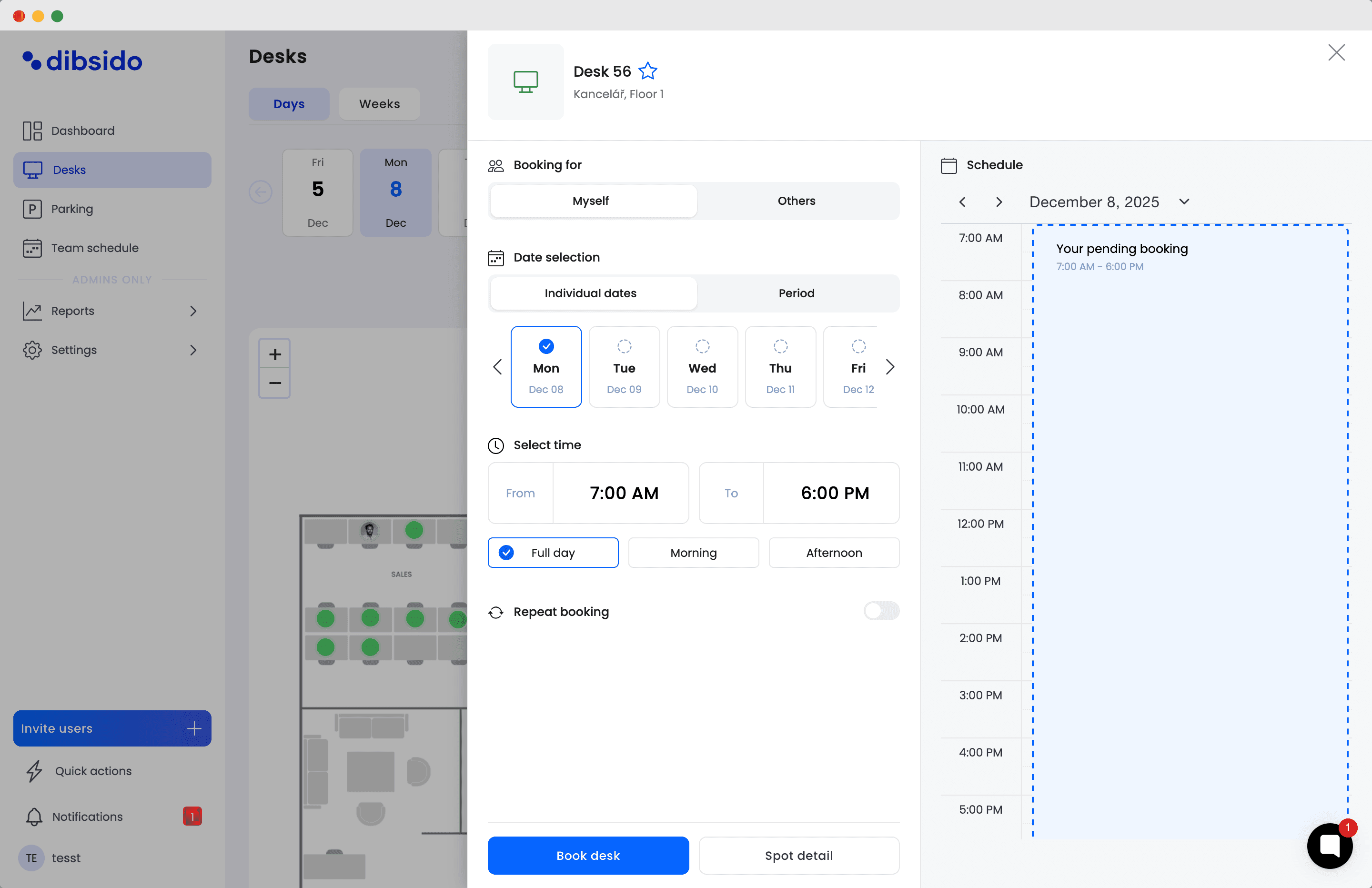
A desk booking tool with a live floor plan is what kills the morning scramble, because a seat is confirmed before anyone leaves home. People can see what is free, pick a desk near their team, and book it for a full day or just the afternoon. Teams that need to sit together can book neighbouring desks. A light check-in step on arrival keeps the map honest, so a booked desk that nobody claims can be released back to the pool instead of sitting blocked, which is the same mechanic that fixes desk booking no-shows. Give everyone a locker for their things, keep the ratio comfortable, and the "no home base" feeling softens considerably.
It is worth being precise about what the technology does and does not do. A booking system shows availability, takes reservations, records check-ins, and surfaces how the space is actually used. It does not set your ratio, write your rules, or decide how to handle the person who books a desk every day and never shows. Those are human calls, and the most common reason a rollout fails is treating the tool as a substitute for them. The software removes the friction; managers set the policy, and getting employees on board early is what turns a mandate into something people accept. If you want the fuller version of that change-management work, our guide to hot desking best practices covers the rules and the rollout in detail.
Done this way, the trade tilts. You keep the cost saving and the flexibility, and you give back most of what people were actually missing: certainty about where they will sit, a place for their things, and a say in how it works.
Frequently asked questions
What is hot desking?
Hot desking is a workspace model where no employee has a permanently assigned desk. Instead, people use whichever desk is free when they arrive, or book one in advance, and the desk returns to the shared pool when they leave. It is common in hybrid offices, where not everyone is in on the same day, so a smaller number of desks can serve a larger team.
What are the main pros and cons of hot desking?
The main pros are lower real estate cost because you provide fewer desks than headcount, flexibility that matches hybrid attendance, and more mixing between teams that would otherwise sit in fixed blocks. The main cons are the loss of a personal home base, hygiene concerns about shared surfaces, the risk of arriving to no free desk on busy days, and a possible hit to focus and belonging if the change is handled poorly.
Why do employees dislike hot desking?
The most common complaints are practical and emotional. Practically, people dislike hunting for a seat, setting up their screen and chair from scratch each day, and having nowhere to keep their things. Emotionally, a fixed desk is a small sense of belonging, and taking it away can feel like a demotion. Shared surfaces also raise hygiene worries. Most of these complaints trace back to a poor setup rather than the idea itself.
Is hot desking a good idea for a small office?
It can be, if attendance is genuinely part-time. A small hybrid office where people come in two or three days a week rarely needs a desk per person, and hot desking lets you keep a smaller, better space. It is a poor fit if the whole team comes in on the same fixed days, or if most roles need a permanent setup such as dual monitors or specialist equipment.
When does hot desking not work?
Hot desking backfires when everyone wants to be in on the same one or two days, because the desk shortage lands all at once. It also struggles when the ratio of people to desks is too aggressive, when roles need fixed equipment, or when it is introduced with no booking system, no storage, and no clear rules. In those cases the savings are real but the daily friction outweighs them.
What desk sharing ratio should you use for hot desking?
There is no universal number. A balanced hybrid office often lands somewhere between 1.4 and 2 people per desk, an office-first culture closer to 1.1 to 1.4, and a remote-first team can go higher. The right ratio depends on your real peak-day attendance, not your headcount. Measure how many people actually come in on your busiest day, leave headroom above that, and revisit the number once you have real booking data.
How do you make hot desking work without upsetting your team?
Involve people early, keep a comfortable ratio so nobody is left standing on peak days, give everyone personal storage such as a locker, and use a booking system with a floor plan so a desk is guaranteed before anyone leaves home. Let teams that need to sit together book neighbouring desks. Publish a short set of rules and apply them evenly. The technology handles availability and booking; managers set the policy and the tone.
Does hot desking actually save money?
Usually yes, when attendance is below full. Providing fewer desks than headcount means less floor space, and office space is one of the largest fixed costs a company carries. The saving is only real if the smaller space still works day to day, which is why the ratio and the booking process matter. Reliable utilization data from a booking tool is what tells you how far you can safely go.
Decide before you rearrange the floor
Hot desking is neither a trap nor a free lunch. It is a way to stop paying for desks that nobody uses, in exchange for taking the daily experience seriously enough to design it. Measure your real peak attendance, choose a ratio you can defend, give people certainty and storage, and the model earns its keep. Skip those steps and you get the savings on paper and the grievances in person.
If you want to see how booking, floor plans, and utilization data come together in practice, take a look at Dibsido desk booking, or try it free and set up a shared floor in a few minutes.
Our platform is designed to empower businesses of all sizes to work smarter and achieve their goals with confidence.