The old way to size an office was simple arithmetic: headcount times a square-footage figure per person, sign the lease, done. Hybrid work broke that math. If half your desks sit empty on an average day, planning space around headcount means paying for room nobody uses. This guide covers the per-person benchmarks people still start from, why they overstate what a hybrid office actually needs, and a practical method to size space around how your team really shows up.

The classic benchmark is roughly 100 to 150 square feet per person for a balanced open-plan office, less for dense hot-desking, more for private offices. It is a starting point, not an answer.
Hybrid work changes the denominator. You no longer need a desk per employee, you need desks for the number of people in on a typical day, which is usually far fewer.
Size from occupancy, not headcount. Measure how full your office actually gets over a few weeks, then plan desks around that peak rather than your payroll.
Space is more than desks. Plan for focus zones, meeting rooms, and collaboration areas, because activity-based demand is what makes an office feel right or wrong.
Plan for where you will be, not only where you are. Office leases run years, so factor in headcount and how your team's working pattern is likely to shift before you commit.
The old way to size an office was simple arithmetic. Take your headcount, multiply by a square-footage figure per person, add a bit for meeting rooms, and that is the lease you sign. For decades it worked well enough, because everyone had a desk and was expected to sit at it five days a week.
Hybrid work broke that math. When people split their time between home and the office, the building is almost never full. Plan space around headcount and you end up paying for desks that sit empty most of the week. Plan it around the wrong number and you either waste money on space nobody uses or, less often, squeeze people into a floor that cannot hold a busy Tuesday.
This guide covers the per-person benchmarks people still reach for first, why those numbers overstate what a hybrid office actually needs, and a practical method to size space around how your team really shows up.
How much office space per person? The benchmarks people start from
There is no single correct number, but there are well-worn ranges. As a rough starting point:
Office style | Approximate space per person |
|---|---|
Dense open plan or hot-desking | 50 to 100 sq ft |
Balanced open plan with meeting rooms | 100 to 150 sq ft |
Mostly private offices | 150 to 250 sq ft |
Before 2020, many companies planned around 200 to 225 square feet per employee all in, counting shared areas. That figure has been falling for years as open-plan layouts replaced private offices, and hybrid work has pushed it down further. A common planning figure today is closer to 100 to 150 square feet per person, with real estate advisors reporting density targets sliding from roughly 165 toward 130 square feet per person as offices right-size around attendance.
The important caveat is hiding in the word "person." These benchmarks assume one desk per person, occupied daily. That assumption is exactly what hybrid work removes, which is why a per-person figure multiplied by your full headcount almost always overstates what you need.
Why the old per-person number breaks under hybrid
Start with how full offices actually are. Across hybrid workplaces, a large share of desks sit empty on any given day. As Fabien Rada, a consultant at real estate firm iO Partners, puts it:
"On any given day, about half of the desks are unoccupied, so optimizing space becomes a natural step."
In the same conversation he notes that almost 40 percent of employees now use shared desks rather than assigned ones.
If half the desks are empty on a normal day, planning one desk per employee means planning a building that is half full by design. That is the gap between the old arithmetic and what a hybrid office needs.
Workplace consultant Michaela Novotna describes how far this can go in practice. Asked how many people fit into a 100-desk office, her answer is up to 250 under a hybrid model:
"Right now, we have clients with 250 employees who are designing offices for only 100 desks. They've already calculated that, thanks to hybrid work, that's all they need."
She adds that when companies actually measure, "occupancy rarely exceeds 55 percent."
The lesson is not that every office should run at a two-and-a-half-to-one ratio. It is that the right amount of space follows how many people are in, not how many you employ.
Size from occupancy, not headcount
The reliable way to plan a hybrid office is to flip the calculation. Instead of starting from payroll, start from how full the office actually gets.
You do not need a sensor system to begin. Novotna's recommendation is refreshingly low-tech:
"a simple manual check over a few weeks is often enough."
Count how many people are in each day, note which days peak, and you will usually find a pattern, with midweek busier than the edges of the week and occupancy well below full capacity.
That peak occupancy, not your headcount, is the number to design desks around. From there the calculation is straightforward:
Estimate the desks you need. Take your realistic peak attendance and add a small buffer so the busiest day still has seats. That is your desk count, and it is usually well below headcount.
Apply a per-desk space figure. Multiply by the space per workstation for your layout, using the benchmark ranges above.
Add shared space. Meeting rooms, focus areas, kitchens, and circulation often account for a quarter to a third of a floor. Plan these around activity, not desk count.
The bridge between headcount and desks is your desk sharing ratio, the number of employees per shared desk. Get that ratio from observed occupancy rather than a guess, and the rest of the space plan follows.
Most hybrid offices land around 0.6 to 0.8 desks per employee, roughly 60 to 80 desks for every 100 people, for teams in two or three days a week. Heavier remote patterns go lower, which is how Novotna's clients reach 100 desks for 250 people.
The payoff is rent. Novotna puts concrete numbers on it for a 50-person company:
"That could mean an office of 500 to 600 square meters, but with the right app, you might only need 300 to 350 square meters. That's half the rent," she explains.
Outside estimates are more conservative but point the same way, with many hybrid organizations running on 20 to 40 percent less space than a traditional setup.
Space is more than desks
Sizing desks correctly is only half the job. The other half is what the rest of the floor is for, and getting that wrong is how an office ends up technically big enough but unpleasant to work in.
Demand has shifted toward variety. People want somewhere quiet to focus and somewhere open to collaborate, and the same desk cannot be both. Rada's firm found that over 40 percent of employees want dedicated areas for focused work because open spaces can be distracting. An office planned as one big desk field, with no quiet zones and too few rooms, fails that test no matter how many square feet it has.
So when you plan shared space, plan it by activity: focus rooms and quiet zones, a realistic number of meeting rooms sized to how teams actually meet, and collaboration areas for the in-person work that draws people in. The point of a hybrid office is the things home cannot offer, and those things need room set aside for them.
Plan for where you will be, not just today
One more reason to be careful with the per-person shortcut: an office is a multi-year commitment. As workplace consultant Nika Milchova points out, "leases are typically five, seven, even ten years long." A space sized only to today's team can be wrong within a year.
Her advice is to look forward before you commit:
"look not just at where you are now, but where you'll be in the future: headcount, team structure, and ways of working."
If you are growing, plan for it. If your working model is still settling, build in flexibility rather than locking into a precise footprint you might regret. A workplace analysis at the start, before the lease is signed, surfaces the capacity questions that are expensive to fix once you have moved in. It is also where the savings come from: as Novotna points out, a well-optimized workspace can save a company a lot of money by matching the space to how people actually work.
How to right-size your office: a simple method
Pulling it together, here is the order that works:
Measure occupancy. Track attendance for a few weeks, by day, to find your real peak and pattern.
Set your desk count. Size desks to peak occupancy plus a buffer, not to headcount.
Choose a per-desk space figure. Use the benchmark ranges for your layout style.
Plan shared space by activity. Focus zones, meeting rooms, and collaboration areas sized to how people actually work.
Project forward. Adjust for likely growth and changing working patterns over the life of the lease.
If you want to put numbers to it quickly, our office space calculator turns headcount and layout into a rough footprint, and the office layout planner helps you visualize how that space lays out. Both are starting points to pressure-test against your own occupancy data.
Where Dibsido fits
The hardest input in all of this is honest occupancy data, and that is the part Dibsido helps with. When desks, rooms, and parking are booked in one place, you can see how often each is actually used rather than relying on a walk-around or a hunch. Utilization reporting turns that into the occupancy pattern your space plan should be built on, so right-sizing decisions rest on data instead of the loudest opinion in the room.
To be clear about the boundary: Dibsido shows you how your current space is used, it does not design floor plans or run space-planning math for you. The benchmarks, the layout, and the lease are decisions for you and, often, a workplace specialist. What the software does is replace guesswork about occupancy with a real number.
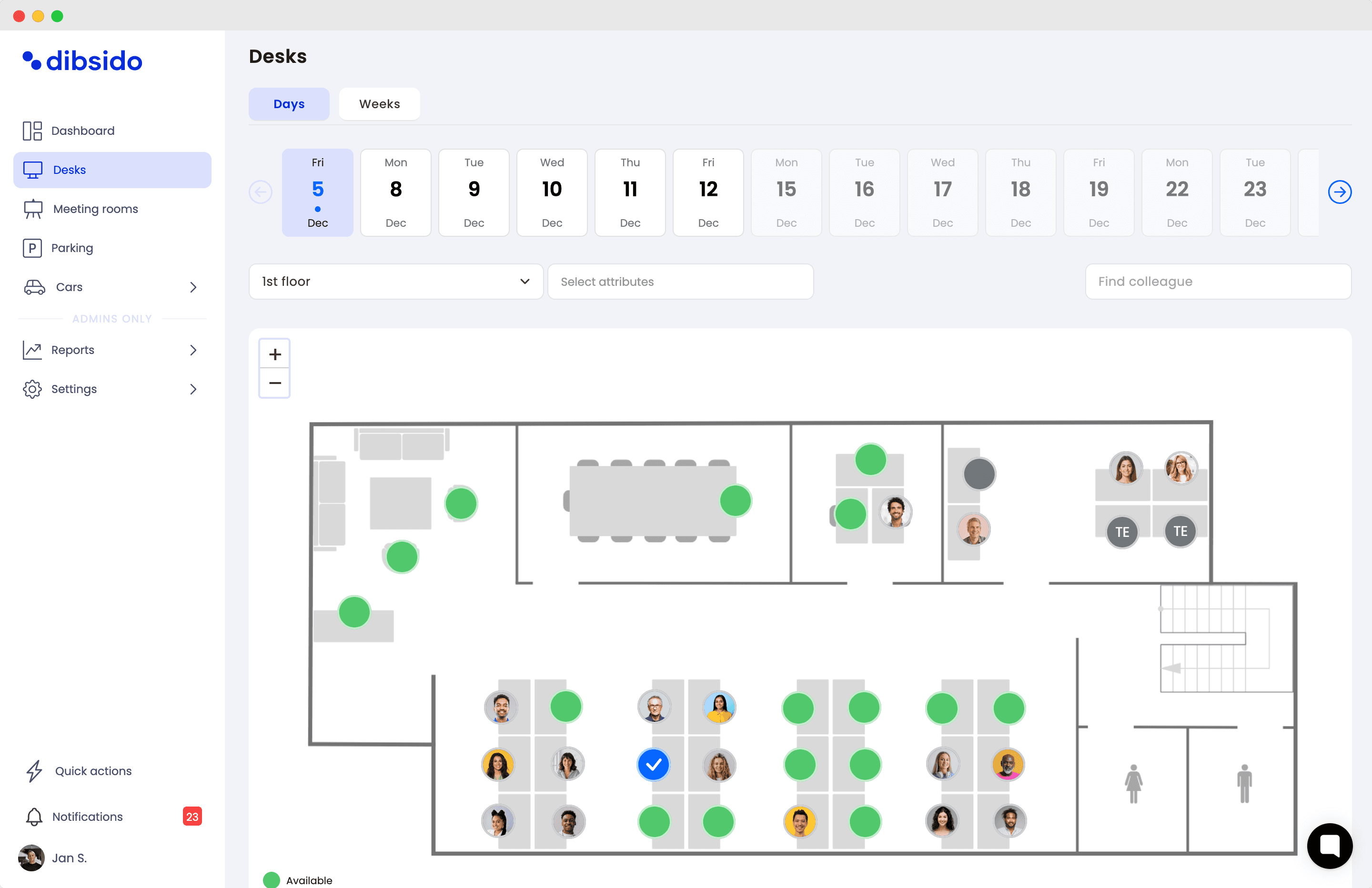
It is built for small to mid-sized hybrid offices rather than enterprise facilities teams, so setup is measured in minutes and the free plan is enough to start tracking how full your office really gets. If you need enterprise-grade workplace analytics or integrated building systems, larger platforms will fit better, and that is a fair trade to weigh.
You can try it free, explore desk booking to see how shared desks work in practice, book a demo to talk through your own numbers, or see pricing if you want the figures first.
Frequently asked questions
How much office space do you need per person?
A common rule of thumb is roughly 100 to 150 square feet per person for a balanced open-plan office. Dense hot-desking layouts can work at 50 to 100 square feet per person, while offices with many private rooms run 150 to 250. These figures assume each person has a daily desk, so treat them as a per-desk starting point rather than a per-employee answer. In a hybrid office you usually need fewer desks than employees, which lowers the total space you need below what a straight headcount calculation suggests.
How do you calculate office space requirements?
Start with the number of desks you actually need, not your headcount. Estimate peak occupancy, the most people in the office on a typical busy day, and plan desks around that. Multiply the desk count by the space per workstation for your layout, then add shared space for meeting rooms, focus areas, kitchens, and circulation, which often accounts for a third or more of the floor. The reliable inputs are real occupancy data and your layout style, not a single per-person multiplier applied to payroll.
What is the average square footage per employee?
Before 2020, many offices planned around 200 to 225 square feet per employee all in, including shared space. That figure has been trending down as open-plan layouts and hybrid work reduce the need for a permanent desk per person, with a common current figure closer to 100 to 150. A useful range by layout is 50 to 100 square feet per person for dense hot-desking, 100 to 150 for balanced open plan, and 150 to 250 where private offices dominate. The average matters less than your own occupancy, because two companies with the same headcount can need very different amounts of space.
How does hybrid work change how much office space you need?
Hybrid work breaks the one desk per employee assumption. When people split time between home and the office, the office is rarely full, so you can plan desks around typical attendance instead of total headcount. Workplace consultants describe companies with hundreds of employees designing offices for a fraction of that many desks because hybrid attendance makes the extra desks unnecessary. The result is that a hybrid office can need meaningfully less space than a headcount-based calculation would suggest, provided you size from real occupancy.
How does desk sharing affect office space planning?
Desk sharing is the mechanism that lets a hybrid office shrink its desk count without turning people away. Instead of a dedicated desk per person, a pool of shared desks is booked as needed, so the number of desks tracks how many people are in rather than how many you employ. The ratio of employees to desks depends on your attendance pattern. Planning that ratio from real occupancy data, rather than guessing, is what keeps a shared-desk office from feeling either crowded or empty.
How do you measure office occupancy?
You do not need a sophisticated sensor system to start. A manual count over a few weeks, recording how many people are in each day and which days peak, is often enough to reveal your real pattern, and most offices find occupancy rarely exceeds about half of capacity. Booking and check-in software gives you the same picture continuously, showing how often desks and rooms are actually used. Either way, the goal is to base space decisions on observed occupancy rather than assumptions.
How much can you reduce office space with hybrid work?
It depends entirely on attendance, but the reductions can be significant. When roughly half the desks sit empty on an average day, the unused space becomes an obvious target, and some companies sublease part of their floor or move to a smaller one. The safe way to find your number is to measure peak occupancy first, then size desks to that peak with a small buffer. Cutting space below your busiest realistic day is how you end up turning people away on Tuesdays.
Should you plan office space for current or future headcount?
Plan for where you expect to be, not only where you are today, because office leases commonly run five to ten years. Factor in likely headcount growth, how your team structure may change, and whether your working pattern is shifting toward more or less in-office time. A workplace analysis at the start, before signing, surfaces capacity questions that are expensive to fix later. The aim is a space that still fits two or three years from now, not just on move-in day.
Our platform is designed to empower businesses of all sizes to work smarter and achieve their goals with confidence.