A hybrid office runs on one shared assumption: the right people are in on the right days. An office attendance policy is what turns that assumption into something your team can actually rely on. Here is what to put in it, a short example to adapt, and how to make it stick without turning your office into a checkpoint.

An office attendance policy defines who is expected in, on which days, and how attendance is measured. It is narrower and more operational than a hybrid work policy.
A policy nobody can see is a policy nobody follows. Pair the written rules with a simple way for people to book and see who is coming in.
Cover the essentials: expected days, anchor days, how presence is defined, exceptions, and what happens when someone repeatedly does not show.
Keep it fair, not punitive. Lead with coordination and desk availability, not badge-swipe surveillance.
Software can show who is booked in, flag no-shows, and surface real attendance patterns. People still set the rules and handle the exceptions.
Every hybrid office runs on one quiet assumption: that the right people will be in on the right days. Sales and the new hire on the same anchor day. Enough desks for whoever shows up. A meeting room that is not half empty because three of the five attendees stayed home.
When that assumption holds, nobody notices. When it breaks, you get the familiar mess: a Tuesday where the office is packed and there are no free desks, a Thursday where the floor is a ghost town, and a manager quietly wondering whether the team is actually coming in at all.
An office attendance policy is how you turn that assumption into something people can rely on. Done well, it is short, fair, and mostly invisible. Done badly, it becomes a badge-report arms race that erodes trust faster than it improves attendance. This guide covers what to include, a short example you can adapt, and how to make the policy stick without turning your office into a checkpoint.
What an office attendance policy actually is
An office attendance policy is a short document that sets out three things: who is expected in the office, on which days, and how attendance is defined and measured. That is it. It is not a manifesto about the future of work, and it should not read like a legal contract.
Its whole job is to replace an unspoken assumption with a shared reference. Without one, in-person expectations live in people's heads, which means they are interpreted differently by every manager and every employee. One team treats "hybrid" as three days in; another treats it as "come in when there is a reason." Both think they are following the same rules. The policy is what makes the rule explicit so it can be applied consistently.
It is worth being precise about scope, because attendance policies are easy to confuse with their bigger sibling. A hybrid work policy sets the broad model: how remote and in-office work is split, who is eligible, and the principles behind the whole arrangement. An attendance policy is the operational layer underneath it. It answers the narrower, more practical question of which days people are actually expected in and how you know whether they were. Most teams benefit from having both, with the attendance policy pointing up to the hybrid model for context.
Why a policy on paper is not the same as attendance in practice
Here is the failure mode that catches teams by surprise. You write a clear policy, you send it round, everyone nods, and three months later attendance looks nothing like the document.
One IT lead described exactly this on social this month. His CEO announced a five-day return-to-office in January and asked IT to start sending leadership weekly badge-access reports. By February, nobody on his team had come into the office on a Friday. The policy existed. The enforcement mechanism existed. Attendance still quietly drifted, and the only thing the badge reports produced was a slightly adversarial relationship between leadership and everyone else.
The lesson is not that policies do not work. It is that a policy people cannot see, cannot plan around, and did not help write tends to become a number on a dashboard that nobody feels responsible for. Attendance holds up when the policy is paired with two things: a reason to come in that people actually value, like a team that is reliably present on the same day, and a simple way to see and plan around who is coming in. Surveillance is a poor substitute for both.
What to include in an office attendance policy
Keep the whole thing to a page or two. A policy people can read in three minutes gets followed. A policy that runs to eight pages gets filed and forgotten. Cover these essentials:
Expected in-office days. The core rule. A number of days per week, specific named days, or a team-by-team expectation. Be explicit rather than aspirational.
Anchor days. One or two fixed days when a team is expected in together. This is often the single most useful line in the policy, because it guarantees overlap instead of leaving everyone to pick different days and never actually meet.
How presence is defined. Does a half day count? What about client visits, offsites, or a day at another location? Say so, so nobody has to guess.
How attendance is recorded. The method matters less than being consistent. Booking a desk for planned days is a low-friction option because it doubles as coordination. Whatever you choose, make it something people already do, not a separate chore.
Exceptions and time off. Illness, caring responsibilities, approved remote periods, and role-based exemptions. A policy with no room for real life reads as a threat and gets quietly ignored.
What happens with repeated non-attendance. Describe a conversation, not an automatic penalty. The point is to notice a pattern early and understand it, not to punish a single missed Friday.
Who owns the policy. Name the office manager, People team, or lead who maintains it and answers questions. An unowned policy goes stale.
An example attendance policy to adapt
Here is a short, neutral example for a mid-sized hybrid office. Treat it as a starting shape, not a template to paste unchanged.
In-office expectation. Team members are expected in the office an average of two days per week.
Anchor day. Wednesday is a company anchor day. Where possible, plan in-person meetings, collaboration, and onboarding for Wednesdays.
Booking. Reserve a desk for each day you plan to be in, ideally by the end of the previous week, so we can see expected numbers and keep enough desks free.
What counts. Client visits, offsites, and approved work at another location count as in-office days. A morning or afternoon in the office counts as a half day.
Exceptions. Illness, caring days, and approved remote periods are exempt. Fully remote roles are listed separately and are out of scope for the day expectation.
If a pattern emerges. If someone is consistently below the expectation without an agreed exception, their manager will have a supportive conversation to understand why before anything else happens.
Owner. The office manager maintains this policy and is the first point of contact for questions.
Notice what is not in there: no badge audits, no automatic strikes, no weekly naming and shaming. The example leans on a clear anchor day and a light booking habit, which is what makes it enforceable without a surveillance layer.
How to make attendance fair, not a surveillance exercise
The fastest way to sink an attendance policy is to make people feel watched. The moment the dominant signal is a badge-swipe report going to leadership, the policy stops being about coordination and starts being about compliance, and people respond to compliance regimes by finding the minimum that satisfies them.
Fair enforcement rests on a few habits. Apply the same expectation across teams so nobody feels singled out. Build in genuine exceptions and honor them. Use attendance data to start a conversation, not to trigger an automatic consequence. And be transparent about what you measure and why, so the policy feels like a shared agreement rather than something done to people.
There is also a fairness dimension in the mechanics. If your policy asks everyone to come in on the same days but you do not have desks or parking for a full house, you have written a rule your building cannot honor. The same principle that underpins a good clean desk policy or a fair parking allocation policy applies here: the rule only works if the resources behind it are managed as carefully as the rule itself. If desks are shared, a hot desking policy template handles booking windows, no-shows and fixed seats.
Where booking data fits
This is where software earns its place, and where it is easy to overclaim, so it is worth being precise about the division of labor.
When people book a desk for the days they plan to be in, you get two things at once. You get a forward view of who is expected in on any given day, which is exactly the coordination signal an attendance policy needs. And you get a record of who actually showed, without adding a separate check-in ritual on top of the booking people already did.
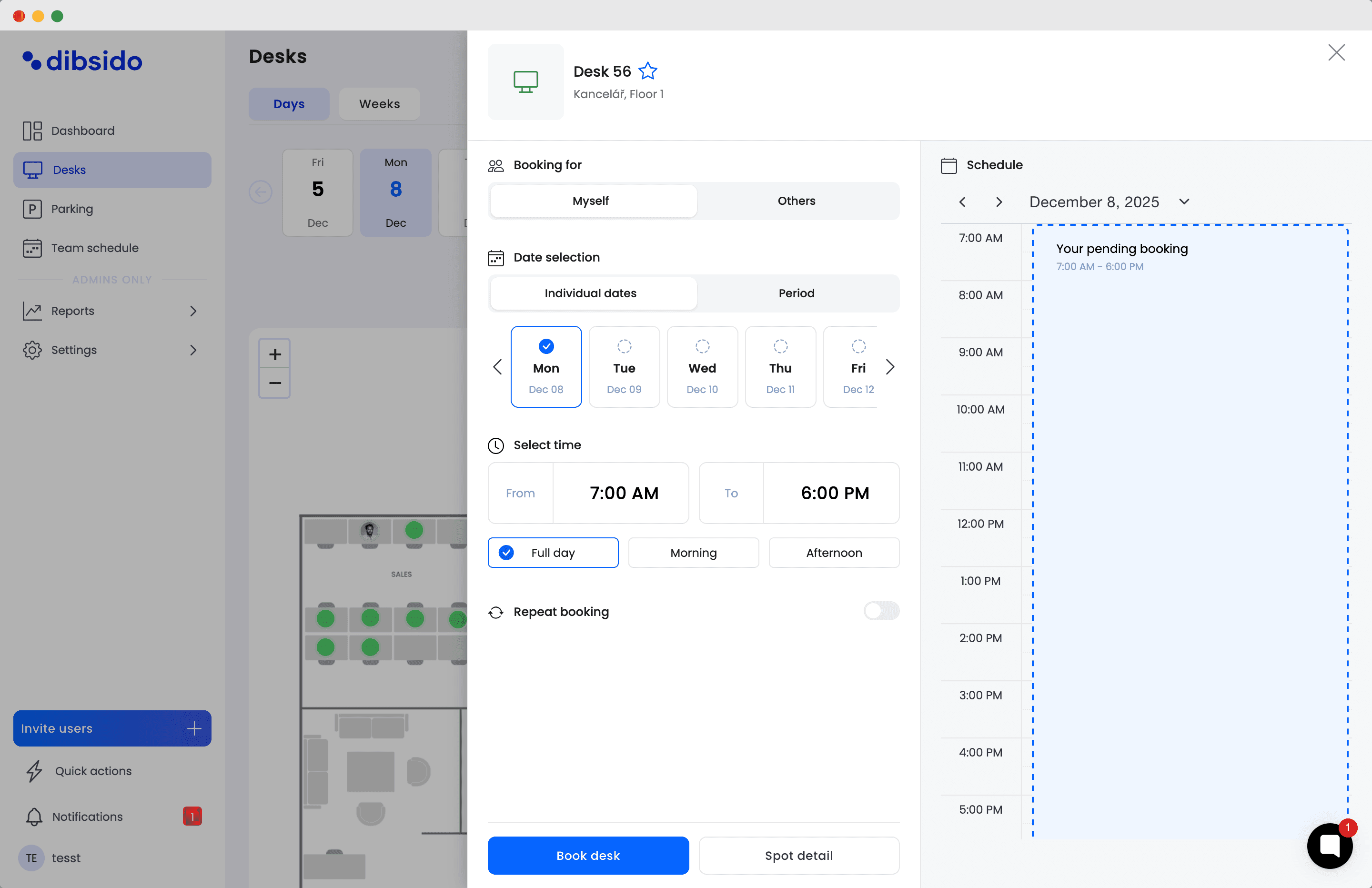
From there, a tool like Dibsido can show who is booked in for a day, flag desk booking no-shows when someone reserves a spot and does not turn up, release unclaimed desks so the space is not wasted, and surface attendance patterns over weeks and months so you can see whether the policy is landing. If you are moving from fixed seats to a shared model, a desk sharing setup makes that forward view even more useful, because the desks themselves become the attendance signal.
What the software does not do is set your rules or discipline anyone. It surfaces the facts. A manager decides what those facts mean and what to do about them. If you want the broader tooling landscape, the hybrid work software guide covers the category. But the order matters: write the policy first, then choose a tool that makes it visible and easy to run. A tool cannot rescue a policy nobody agreed to.
Common mistakes to avoid
Leading with enforcement. If the first thing people hear about the policy is how it will be policed, you have lost them. Lead with the reason to come in.
A day count with no anchor. "Two days a week" where everyone picks different days produces an office that is always a bit busy and never actually together. Name an anchor day.
Writing a rule your space cannot honor. Do not mandate five days in a building with desks for sixty percent of the team. Match the policy to the resources.
No exceptions. A policy with no room for illness or caring responsibilities reads as hostile and gets ignored.
Set and forget. Attendance patterns shift. Revisit the policy each quarter using real data, not the assumptions you had when you wrote it.
An office attendance policy is not a way to force people into the building. It is a way to make the in-person days worth showing up for and easy to plan around. Get the rule clear, keep it fair, give people a simple way to see who is coming in, and most of the enforcement takes care of itself.
Frequently asked questions
What is an office attendance policy?
An office attendance policy is a short document that sets out who is expected in the office, on which days, and how attendance is defined and measured. It gives managers and employees a shared reference for in-person expectations so attendance is a known rule rather than an unspoken assumption.
What should an office attendance policy include?
A workable policy covers the expected number of in-office days, any fixed anchor days, how presence is defined, how attendance is recorded, the process for exceptions and time off, what happens when someone repeatedly does not attend, and who owns the policy. Keep it to a page or two so people actually read it.
How is an office attendance policy different from a hybrid work policy?
A hybrid work policy sets the broad model: how remote and in-office work is split, who is eligible, and the principles behind it. An office attendance policy is the operational layer underneath it. It answers the narrower question of which days people are actually expected in and how that is tracked. Many teams keep both, with the attendance policy referencing the hybrid model.
How do you enforce an office attendance policy fairly?
Fair enforcement starts with clear expectations, applied consistently across teams, with room for genuine exceptions. Use attendance data to spot patterns and start a conversation, not to hand out automatic penalties. The tool surfaces the facts. A manager decides what to do with them.
How do you track office attendance without micromanaging?
Tie attendance to something people already do, like booking a desk for the days they plan to come in. That gives you a forward view of who is expected in and a record of who actually showed, without adding a separate check-in ritual or badge-report culture. The goal is coordination, not surveillance.
What are anchor days in an attendance policy?
Anchor days are fixed days when a team is all expected in together, so meetings, collaboration, and onboarding happen with everyone present. Naming one or two anchor days is usually more effective than a blanket day count, because it guarantees overlap instead of leaving everyone to pick different days.
How many days a week should employees be in the office?
There is no universal number. Common hybrid patterns range from one to three set days a week. What matters more than the count is that the days overlap for teams that need to collaborate, that the policy is realistic for your space, and that it is applied consistently. Pick a pattern you can actually staff and desk.
Can attendance tracking software set the policy for you?
No. Software can show who is booked in, flag no-shows, release unclaimed desks, and surface real attendance patterns over time, but it does not decide your rules or discipline anyone. The policy is a human decision. The software just makes it visible and easy to run day to day.
Our platform is designed to empower businesses of all sizes to work smarter and achieve their goals with confidence.