If you are weighing up Dibsido against other workplace booking tools, here is a straight comparison: what Dibsido is genuinely best at, who might want an alternative, and five options worth shortlisting, each with honest pros and cons.

Dibsido is a strong fit for hybrid offices from small teams up to a few hundred employees that want desks, meeting rooms and parking in one place with native Microsoft Teams and Slack booking; a free plan covers teams up to 10 users.
You might want an alternative if you want vendor-supplied ePaper room displays at every door, a visitor-management-first platform, or heavyweight enterprise analytics.
Five alternatives worth comparing in 2026: Skedda, Robin, Envoy, Joan and OfficeRnD. Each is strong for a different kind of office.
Pricing models differ a lot: per user, per room, per space, per bookable resource and per device all appear here, so a headline price rarely reflects the real bill.
Trial two tools on a real team before deciding. A free plan or trial is the fastest way to learn what you actually need.
You have probably landed here because you are evaluating Dibsido against other workplace booking tools, or you already use one tool and want to sanity-check what else is out there. Either way, the honest answer is that there is no single best workplace booking software. The right pick depends on how your team books, what hardware you want at the door, and what you are willing to pay once every desk, room and user is counted.
This guide does two things. First, it lays out what Dibsido is genuinely best at and who might reasonably want something else. Second, it compares five alternatives worth shortlisting in 2026 for a small or mid-sized hybrid office, each with dated pricing and an honest note on where it is weak. Every price below was checked on the vendor's own site in August 2026, and Dibsido gets the same honest treatment as everyone else.
What Dibsido is best at
Dibsido is a workplace booking platform for hybrid offices that are big enough for desks, rooms and parking to need real coordination, but where nobody wants an enterprise rollout: from small teams up to a few hundred people. It covers desk booking, meeting room booking and parking in one place, so you are not stitching three tools together. A few things it does well:
A free plan that is actually usable. The free tier covers up to 10 users with no time limit and no card, so you can run the real workflow before you pay (dibsido.com, August 2026).
Native booking inside Microsoft Teams and Slack. People book a desk or room where they already work, which is the single biggest driver of whether a booking tool actually gets used. On paid plans it also syncs two ways with Outlook and Google Calendar.
Modular pricing. You pay for the modules you use, desks, rooms or parking, rather than a forced bundle. That keeps the bill honest for a small office that only needs one or two of them.
A clear, admin-editable floor plan and check-in. People see what is free at a glance, and check-in plus no-show tracking surface the desks and rooms that were booked but never used.
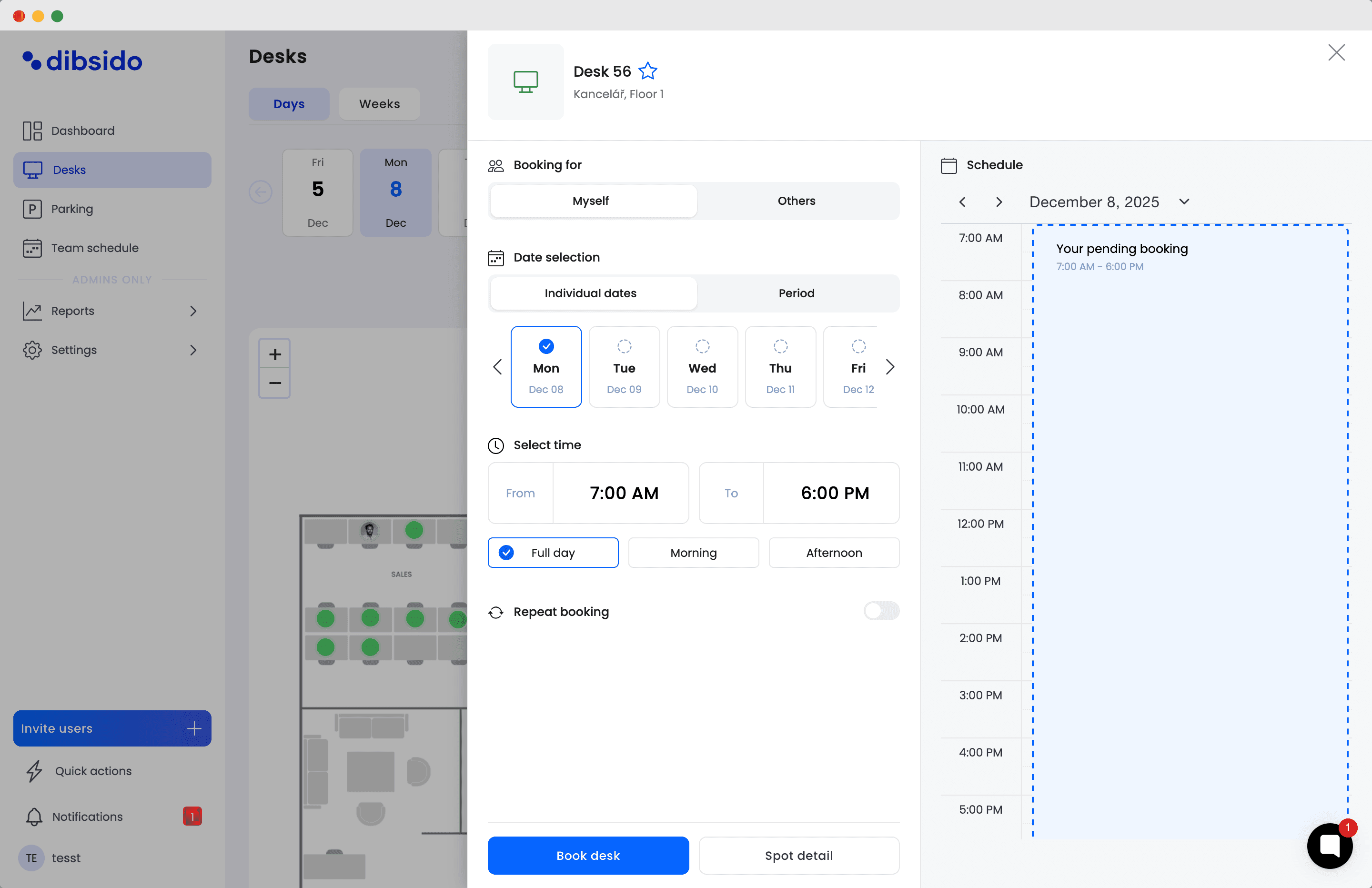
It also scales up. Dibsido runs in 200-plus person offices, so a small team that starts on the free plan is not forced to migrate as it grows. For the wider category picture, our desk booking software guide and meeting room booking software guide walk through how the tools work and what to look for.
Who might want an alternative to Dibsido
Being honest about fit is the fastest way to a good decision. You might prefer one of the alternatives below if:
You want vendor-supplied ePaper displays at every door. Dibsido's meeting-room module includes a room-display view you can run on any tablet mounted at the door, but Dibsido does not sell display hardware itself. If you want the vendor to ship dedicated ePaper devices, a display specialist fits better.
Visitor management is your headline need. If reception sign-in, badge printing and host notifications matter more than desk and room booking, a visitor-first platform will lead with what you need.
You need heavyweight enterprise space analytics. For a large flex or coworking program with deep utilization modelling, an analytics-heavy platform may go further than a lightweight booking tool.
If none of those is your priority, an all-in-one booking tool with a free plan usually covers a small or mid-sized hybrid office comfortably. If your comparison is specifically against another vendor, we also keep dedicated head-to-head pages for Robin, Envoy, deskbird and Kadence.
5 Dibsido alternatives worth comparing in 2026
1. Skedda: best for map-first space booking
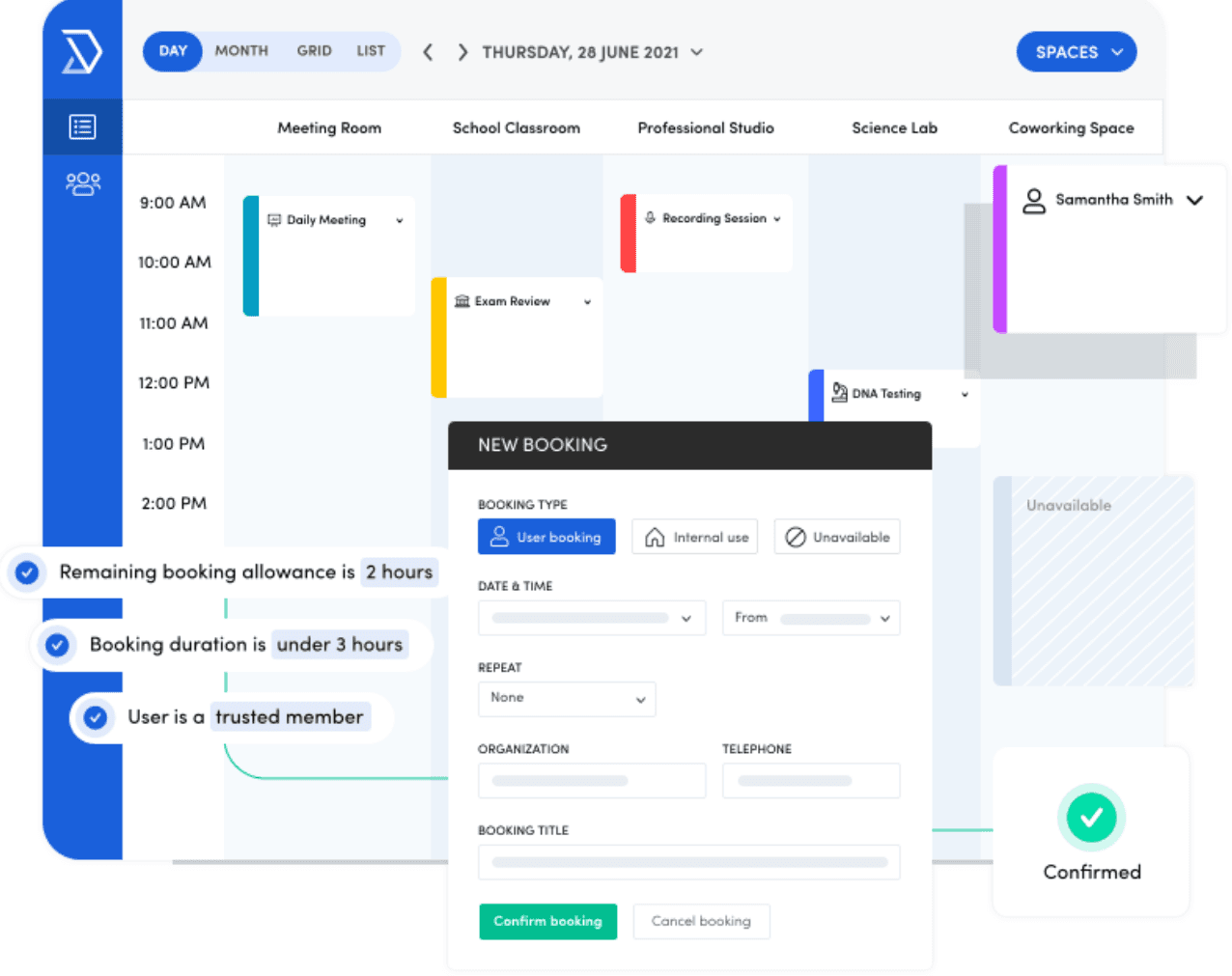
Skedda is a space-scheduling tool built around an interactive map of your bookable spaces. It is a close like-for-like alternative if you prefer a visual, map-first way to book desks and rooms and you do not need a permanent free plan.
Skedda prices per space (a bookable desk, room or area) and offers a 30-day free trial rather than a permanent free tier. Its EMEA and APAC plans as of August 2026 (skedda.com):
Starter: 99 US dollars per month, 15 spaces
Plus: 149 US dollars per month, 20 spaces
Premier: 199 US dollars per month, 25 spaces
US and Canada pricing is listed separately and starts higher: there is no Starter tier, and Plus begins at 249 US dollars per month for 35 spaces (skedda.com, August 2026).
Cons: pricing is per space, which adds up as you grow, there is no permanent free plan, and its native meeting-room hardware story is lighter than a display-first vendor's. We keep a fuller side-by-side in our Skedda alternatives comparison.
2. Robin: best for US offices pairing rooms with hardware and analytics
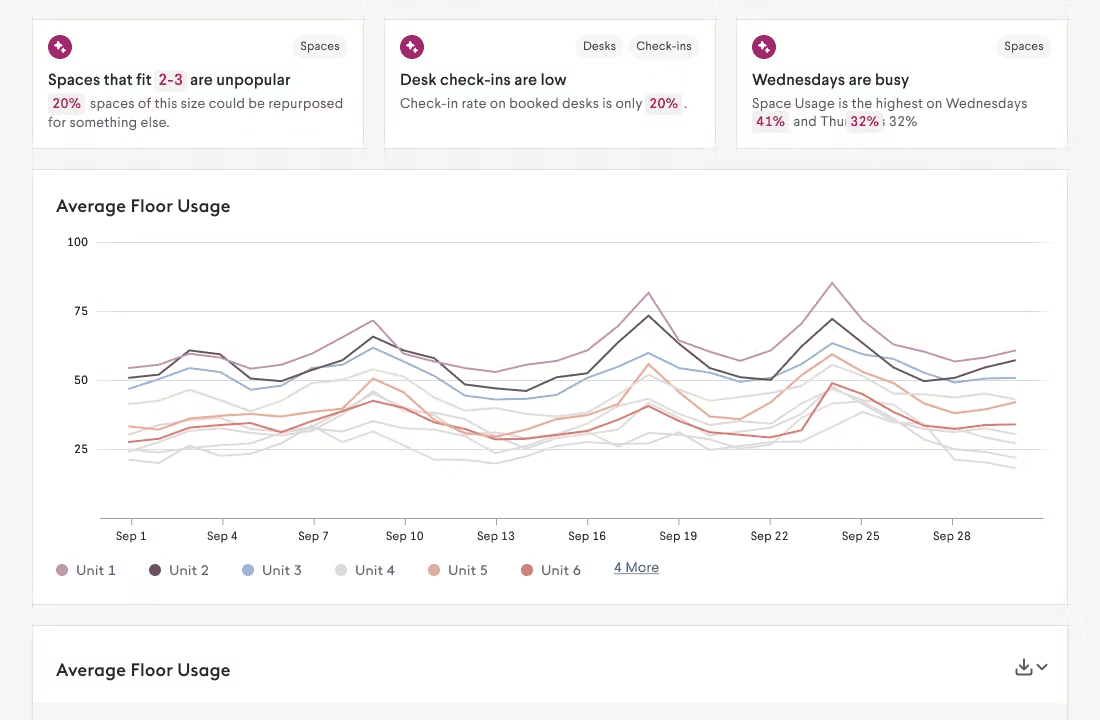
Robin is a workplace platform popular with larger US offices that pair desk and room booking with room-display hardware and usage analytics. It leans toward a guided sales process rather than self-serve.
Robin does not publish pricing; the site invites you to complete a form to speak with the team and receive a quote tailored to your organisation, and no free plan is shown (robinpowered.com, August 2026).
Cons: the demo-gated, quote-only model means you cannot self-serve or compare a price up front, which is friction for a small office that just wants to trial a workflow this week.
3. Envoy: best for offices that lead with visitor management
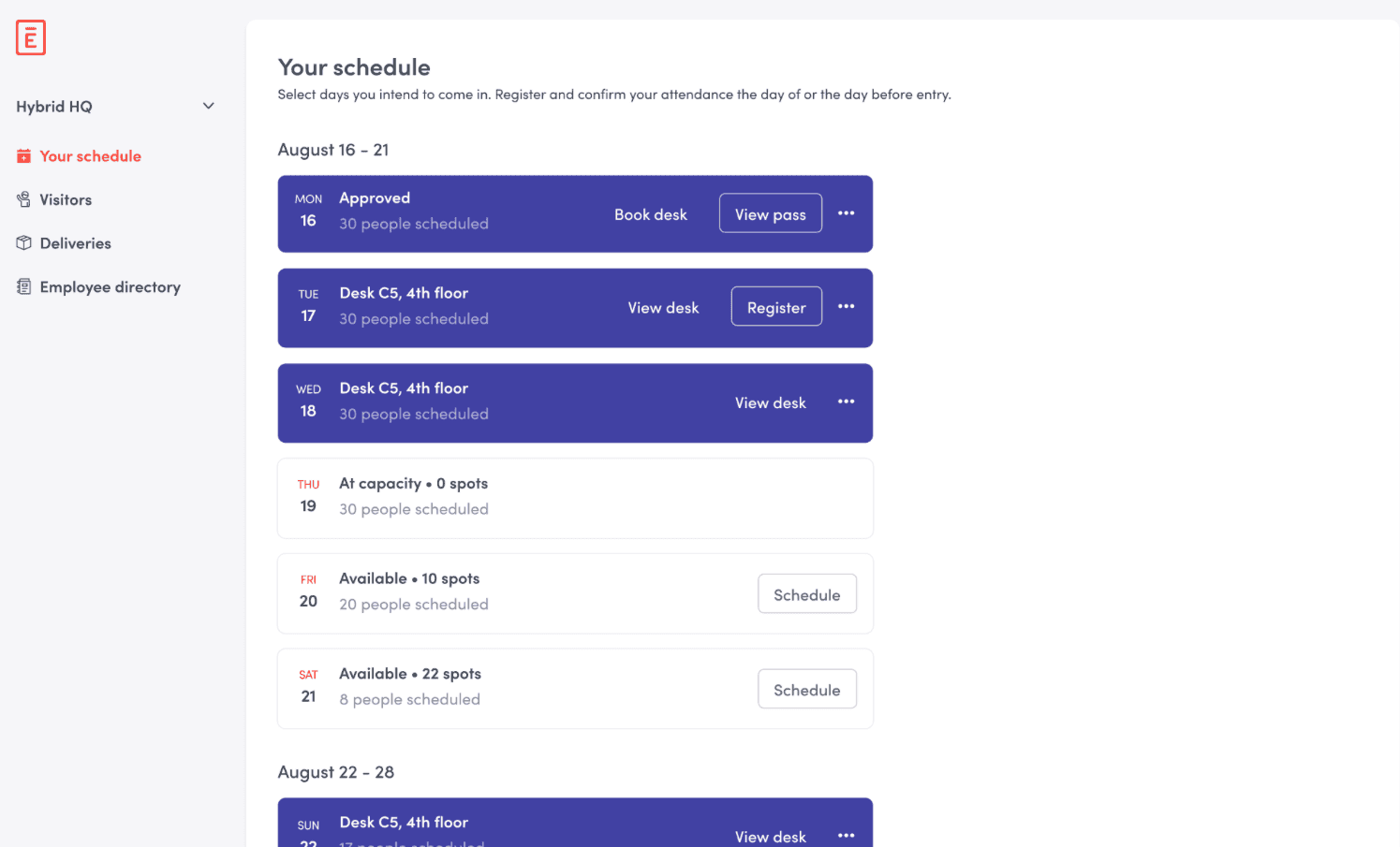
Envoy started with visitor management and expanded into desk and room booking. If reception sign-in and visitor flows are your headline need and rooms are secondary, Envoy leads with the part you care about.
Envoy has a free tier for its Visitors product, but room booking is not free: Reservations is listed at 5 US dollars per bookable resource per month on annual billing, and the visitor Premium plan is 362 US dollars per location per month (envoy.com, August 2026).
Cons: room and desk booking are add-ons to a visitor-first platform rather than the headline product, and the free tier covers Visitors, not booking, so a booking-only buyer pays from day one.
4. Joan: best for physical room displays at the door
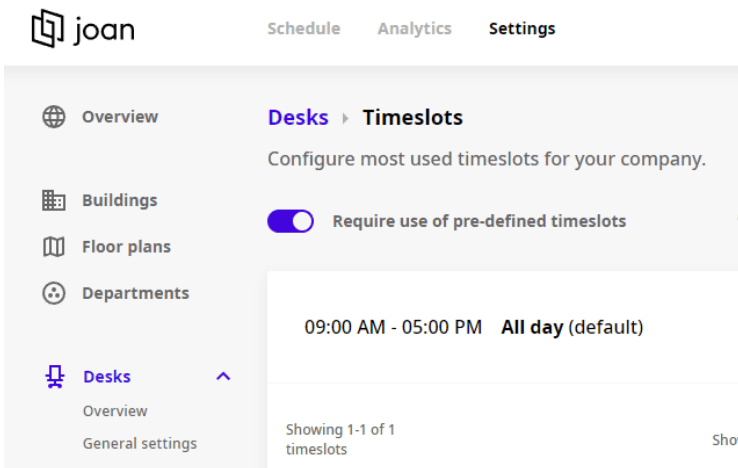
Joan, a European vendor, is built around room-status displays, including its own ePaper devices, plus booking software for rooms and desks. If you want a screen outside each room showing whether it is free and letting people book or release it on the spot, Joan is the specialist and the clearest reason to look past an all-in-one booking tool.
Joan is usage-based rather than tiered: plans start at 51 US dollars per month, with additional users at 1.09 US dollars per user per month and additional devices at 10.99 US dollars per device per month on annual billing. Hardware is not required; Joan works with its own ePaper devices or any tablet or display (getjoan.com, August 2026).
Cons: the value centres on displays and hardware, per-device costs accumulate across a lot of rooms, and desk booking is secondary to the room-display focus.
5. OfficeRnD: best for analytics-heavy hybrid and flex programs
OfficeRnD offers a hybrid workplace product and a flex product for coworking spaces. It fits a larger or more analytics-driven program that wants detailed utilization data and is willing to invest in setup.
OfficeRnD Hybrid starts around 99 euros per month on annual billing for up to 150 users, with per-bookable-resource and per-meeting-room add-ons, a Professional tier for up to 1,000 users, and custom Enterprise pricing. No free tier is shown (officernd.com, August 2026).
Cons: no free plan, a steeper setup and learning curve than a lightweight tool, and per-room plus per-resource pricing that a small office can find heavier than it needs.
Quick comparison
Tool | Best for | Pricing model (Aug 2026) | Free plan | Native Teams/Slack booking |
|---|---|---|---|---|
Dibsido | Free plan, native Teams and Slack booking, all-in-one desks, rooms and parking | Modular, per module and per user | Yes, up to 10 users | Yes |
Skedda | Map-first space booking | Per space, from 99 USD/mo (EMEA) or 249 USD/mo (US) | No, 30-day trial | Integrations |
Robin | US offices pairing rooms with hardware and analytics | Quote-only, per organisation | No | Integrations |
Envoy | Visitor-management-first offices | Reservations from 5 USD per resource/mo | Visitors only, not booking | Integrations |
Joan | Physical room displays at the door | From 51 USD/mo, per user and device | No | Integrations |
OfficeRnD | Analytics-heavy hybrid and flex | From 99 EUR/mo, per user | No | Integrations |
Figures were taken from each vendor's pricing page in August 2026 and are shown as starting prices. Always confirm the current figure and your own room and user counts on the vendor's site before deciding.
How to choose in five minutes
You do not need a spreadsheet with 40 rows. Four questions settle most decisions:
Do you need a screen at every door? If yes, Joan is the specialist. If no, you can skip the hardware-first tools.
Is visitor management the main job? If reception sign-in matters more than booking, Envoy leads with it. If booking is the point, an all-in-one tool fits better.
Do you want to try it free first? Dibsido's free plan lets you run the real workflow with the actual team before you pay, and Skedda gives you a 30-day trial. Robin and OfficeRnD will want a conversation first.
How do people book today? If your team lives in Microsoft Teams, Slack and Outlook, prioritise native booking and two-way calendar sync so a booking made in one place shows up everywhere and a room is never double-booked.
Whatever you shortlist, trial two tools with a real team for a week. The tool people actually use beats the one with the longest feature list. And remember the software surfaces availability and flags no-shows; a person still sets the rules for who can book what.
Try Dibsido on a real team this week
If an all-in-one booking tool with a free plan sounds like the right shape, you can start a free trial in about five minutes, book a demo to see it with your own floor plan, or check the pricing page to model your desks, rooms and parking. Start with desk booking or meeting room booking and add the rest as you grow.
Frequently asked questions
What are the best alternatives to Dibsido?
Five workplace booking tools worth comparing with Dibsido in 2026 are Skedda, Robin, Envoy, Joan and OfficeRnD. Skedda suits map-first space booking. Robin suits US offices pairing rooms with hardware and analytics. Envoy suits offices that lead with visitor management. Joan suits offices that want physical room displays at the door. OfficeRnD suits analytics-heavy hybrid and flex programs. The right pick depends on how your team books and your total cost once every room and user is counted, not on a headline price.
Is Dibsido a good desk and room booking tool?
Dibsido is built for hybrid offices from small teams up to a few hundred employees that want desks, meeting rooms and parking in one tool with fast self-serve setup. Its strengths are a free plan for up to 10 users, native booking inside Microsoft Teams and Slack, modular pricing so you only pay for the modules you use, and an interactive floor plan. It is less of a fit if you want vendor-supplied room-display hardware or a visitor-management-first platform, which is where some alternatives are stronger; Dibsido runs a room-display view on any tablet but does not sell devices.
Why would you choose an alternative to Dibsido?
Common reasons are wanting vendor-supplied ePaper room displays (Dibsido runs a room-display view on any tablet but does not sell the hardware), wanting visitor management as the headline product rather than an add-on, or needing enterprise-grade space analytics for a large flex or coworking program. Joan specialises in room displays, Envoy leads with visitor management, and OfficeRnD leans into analytics-heavy hybrid programs. If none of those is your priority, an all-in-one booking tool with a free plan usually covers a small or mid-sized hybrid office.
Which Dibsido alternative is best for Microsoft Teams and Slack?
If most bookings should happen where people already work, look for two-way calendar sync with Outlook or Google and the ability to book without leaving Teams or Slack. Dibsido supports native booking inside Microsoft Teams and Slack plus two-way Outlook and Google Calendar sync on its paid plans. Robin and Envoy also integrate with Microsoft 365. Confirm the sync is two-way, not one-way, before you commit, because a one-way sync can still leave a room double-booked.
Is there a free alternative to Dibsido?
Free plans in this category are limited. Dibsido itself has a free plan for up to 10 users with no time limit and no card. Among the alternatives, Skedda offers a 30-day trial rather than a permanent free tier, Envoy has a free tier for its Visitors product but room booking sits in its paid Reservations add-on, and Robin and OfficeRnD do not publish a free plan (vendor sites, August 2026). A free plan or trial is most useful for testing the booking workflow before you pay to scale up.
How much do Dibsido alternatives cost?
Pricing models differ, so compare total cost, not headline price. As of August 2026: Skedda is priced per space from about 99 US dollars per month; Envoy Reservations is 5 US dollars per bookable resource per month on annual billing; Joan starts around 51 US dollars per month with per-user and per-device add-ons; OfficeRnD starts around 99 euros per month annually with per-room and per-resource add-ons; Robin publishes no pricing and quotes per organisation. Dibsido charges per module on a modular plan with a free tier. Add up every room and user before comparing.
What is the best Dibsido alternative for a small hybrid office?
Small and mid-sized hybrid offices usually want fast self-serve setup, a free or low-cost plan, and booking where the team already works. Skedda is the closest like-for-like if you prefer a map-first tool, and Joan fits if you want a display at each door. For most offices this size the deciding factors are the free plan, native Teams and Slack booking, and whether you need desks, rooms and parking together. Trial two options with the actual team before you decide.
Does Dibsido handle desks, meeting rooms and parking?
Yes. Dibsido covers desk booking, meeting room booking and parking booking in one platform, with an interactive floor plan, check-in and utilization reporting. Pricing is modular, so you add only the modules you use. The software surfaces availability and usage and flags no-shows; a person still sets the rules for who can book what and handles exceptions.
Our platform is designed to empower businesses of all sizes to work smarter and achieve their goals with confidence.