If your to-do list grows faster than you can check things off, you're probably stuck in the urgency trap — spending your day on whatever screams loudest while the work that actually matters gets pushed to "later." Here's how to break the cycle.
What's the Urgency Trap?
At Dibsido, we know one thing for sure: Office managers have a lot on their plates. Urgent emails, last-minute requests, lots of these "quick tasks" that are anything but quick. 🫠 It's so easy to fall into the urgency trap.
It's when you end up prioritizing the tasks that feel most pressing, even if they're not necessarily the most important, and in the process, the bigger, more meaningful tasks get pushed aside for later.
When your to-do list feels like it's growing faster than you can handle, it's time to get organized. Here's a tool that has saved me countless times:
📌 The Eisenhower matrix — The office manager edition
Sort all your tasks into four categories:
✅ Urgent and important >>> Drop everything and do these first.
✅ Important but not urgent >>> Schedule and timeblock them into your calendar. If you don't, they'll turn urgent real soon.
✅ Urgent but not important >>> Forward them, delegate them, or get ChatGPT to help you.
✅ Neither urgent nor important >>> Eliminate them if possible, or batch them for later. Set aside an hour each week to knock out these low-priority tasks.
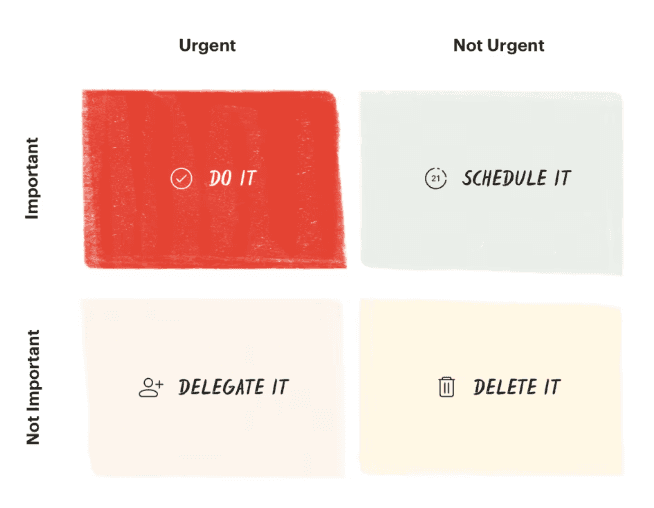
Source: https://www.todoist.com/productivity-methods/eisenhower-matrix
Where the Eisenhower Matrix Comes From
The matrix is named after U.S. President Dwight D. Eisenhower, who famously said: "What is important is seldom urgent, and what is urgent is seldom important." The framework was later popularized by Stephen Covey in The 7 Habits of Highly Effective People, where it became one of the most widely used prioritization tools in personal and professional productivity.
The reason it works so well for office managers specifically is that the role is inherently reactive. You're the person everyone comes to when something needs handling — which means your day fills up with other people's urgencies if you don't actively protect your own priorities.
Making It Stick: A Weekly Routine
The matrix is only useful if you actually use it. Here's a simple weekly routine to turn it from a concept into a habit:
Monday morning (15 minutes): List everything on your plate for the week. Sort each item into one of the four quadrants. Be honest — most "urgent" tasks are really just "loud."
Daily check-in (5 minutes): Before diving into email, review your quadrant 2 items (important but not urgent). Block time for at least one of them today.
Friday review (10 minutes): Look at what you actually worked on. If you spent the whole week in quadrant 1 (urgent + important) and quadrant 3 (urgent + not important), your system needs adjusting.
The office managers who avoid burnout aren't the ones who work the hardest — they're the ones who protect their time for the work that matters most.
If desk bookings and parking spats keep landing in your urgent-and-important quadrant, that's because they have no system. Dibsido gives them one. Try it free for 14 days, no card needed.